
Finding qualified candidates isn't a visibility problem. It's a targeting problem. The teams that hire well consistently do three things: they define precisely who they're looking for before searching, they go where qualified candidates actually are, and they screen with structure rather than instinct.
This guide walks through a repeatable approach — from role definition to structured screening — covering what to set up before you start, which channels work for which roles, and where most hiring processes quietly break down.
TL;DR
- Start with a precise role definition — vague criteria produce volume, not quality.
- Outbound sourcing (actively searching candidate databases) consistently outperforms post-and-wait for specialized or competitive roles.
- Match your channel to your role type: job boards for high-volume positions, direct search for specialized or senior hires.
- Candidate quality comes from skills proficiency and role fit — not keyword matches on a resume.
- Top efficiency killers: undefined criteria, single-channel reliance, and skipping structured screening.
How to Find Qualified Job Candidates Efficiently
Step 1: Define the Role and Qualification Criteria Before Sourcing
Sourcing without a clear candidate profile generates applicants — just not the right ones.
A strong role definition includes:
- Required skills with proficiency levels — not just job titles
- Years of relevant experience — and what that experience should demonstrate
- Location or remote parameters — and whether they're flexible
- Must-have vs. nice-to-have criteria — written down and agreed upon before anyone starts searching
The distinction between competency-based and title-based criteria matters more than most teams realize. McKinsey research found that skills-based hiring is 5x more predictive of on-the-job performance than education-based recruitment. A candidate who held the right title at a previous company doesn't automatically have the skills your role requires.
One often-overlooked element: compensation. 44% of job seekers are unlikely to apply to a posting that doesn't include a pay range, and 45% say omitting it is disrespectful. Including salary upfront filters out mismatched candidates early — which saves time on both sides.
Before sourcing, document:
- An ideal candidate profile (skills, experience, location, compensation range)
- A clear separation of mandatory vs. preferred qualifications
- Pre-agreed screening questions tied to the must-have criteria
This document becomes the filter every subsequent decision runs through.
Step 2: Select and Prioritize the Right Sourcing Channels
No single channel reaches all qualified candidates. The right channel depends on the role type — and using the wrong one is a structural problem, not a messaging problem.
| Role Type | Best-Fit Channels |
|---|---|
| High-volume or entry-level | Indeed, ZipRecruiter, general job boards |
| Mid-level professional | LinkedIn, company careers page |
| Specialized or technical | Niche platforms (Wellfound for tech/startups, Behance for creative) |
| Trust-based, culture-fit hires | Employee referral programs |
Data backs the shift toward proactive sourcing: 62% of talent teams report finding higher-quality candidates through outbound search than through inbound applications. Yet most hiring processes still default to post-and-wait.
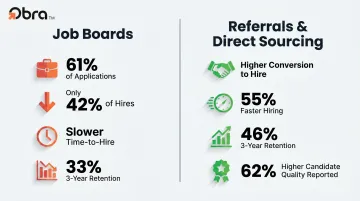
The numbers explain why that's a problem: job boards produced 61% of applications but only 42% of hires in 2024, while referrals and direct sourcing consistently convert at higher rates. Referred candidates are hired 55% faster than career-site hires, and their 3-year retention rate is 46% versus 33% for job board hires.
For competitive or specialized roles, inbound alone structurally excludes the candidates most likely to succeed — because those people already have jobs and aren't refreshing job boards.
Step 3: Execute a Proactive, Outbound Candidate Search
Outbound sourcing flips the model: instead of waiting for applicants, you search candidate databases directly and reach out before anyone else does. The access advantage is significant — 70% of the workforce isn't actively job searching, which means inbound-only approaches miss most of the qualified pool by default.
That matters because recruiters already spend an average of 13 hours per week sourcing candidates for a single role. Without a targeted approach, that time compounds quickly without producing better results.
Obra Hire gives hiring teams direct access to 800M+ candidate profiles, searchable by job title, skills, location, and years of experience. The AI-powered matching system uses structured competency data — not resume keyword matching — to rank results against your defined must-have and nice-to-have criteria.
The search process works like this:
- Describe your ideal candidate in natural language or paste a job description
- Set filters (job title, skills, location, experience level)
- Preview the estimated pool size and individual profiles — no credits required at this stage
- Adjust filters until the pool matches your target size and quality
- Reveal contact details (email, phone, LinkedIn, and resume) for candidates worth pursuing — all unlocked simultaneously with a single credit
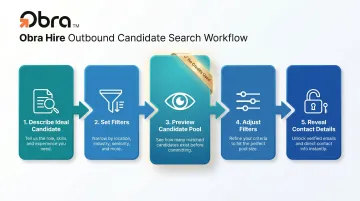
The preview step is what makes the workflow low-risk. Teams confirm result quality before spending anything — and when a candidate is worth pursuing, outreach goes directly to them, bypassing third-party intermediaries and connection request delays.
Obra Hire's Free plan includes 50 contact credits and 1,000 profile views monthly, with unlimited searches on all tiers. The Explore plan ($109/month) includes 500 credits; Scale ($169/month) provides 1,200 credits per license with team collaboration features, shared credits, and centralized admin controls.
Step 4: Apply Structured Screening to Filter for True Qualification
Finding candidates is half the job. Screening them efficiently without inconsistency is where most hiring processes break down.
Structured screening means standardizing the evaluation process before the first candidate enters it:
- Pre-screening questions tied directly to must-have criteria (not generic questions)
- Skills-based assessments for roles where technical competency is critical
- Consistent evaluation rubrics shared across everyone involved in hiring decisions
Unstructured screening relies on interviewer instinct, which varies between people and introduces bias. Structured interviews outperform unstructured ones in predictive validity — and they reduce the interviewer-to-interviewer inconsistency that turns hiring into guesswork.
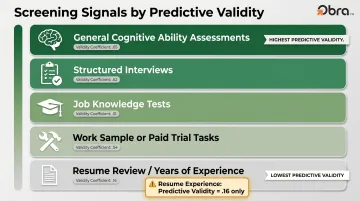
Screening signals ranked by predictive validity:
- General cognitive ability assessments
- Structured interviews with standardized questions
- Job knowledge tests
- Work sample tests or paid trial tasks
- Portfolio reviews (for creative/technical roles)
Resume review alone is near the bottom of the predictive validity stack. Years of experience, for instance, has a predictive validity of only .16 for job performance — and that predictive value largely plateaus after the first five years on the job.
Short paid trial tasks or portfolio reviews surface actual competency faster than any interview question. They also set a clear quality bar that the rest of your hiring team can evaluate consistently.
When Should You Use Outbound Candidate Sourcing?
Outbound isn't always necessary. For entry-level roles with strong candidate supply, well-known employer brands, or high-volume positions where application quantity is an asset, inbound job postings work fine.
Outbound becomes the primary strategy when:
- The role requires a rare or specialized skill combination that rarely appears in active applicant pools
- You're hiring in a competitive market where top candidates are already employed
- Time-to-fill pressure is real — the average time-to-fill is 42 days, and top candidates are typically off the market within 10 days
- The role is senior or technical (technology roles average 52 days to fill; senior tech roles average 71 days)
- Previous inbound postings drove volume but few qualified candidates
In practice, the two approaches work best together. Use outbound to build a proactive pipeline of matched candidates while inbound handles volume for roles that attract strong applicants on their own. Either way, track results by source — not just application counts, but how many candidates advanced to interviews and converted to hires. That's the metric that actually tells you what's working.
Key Variables That Determine Candidate Quality
The goal of sourcing isn't a full pipeline — it's a pipeline with a high probability of producing a successful hire. Several variables directly control which outcome you get.
Job Description Specificity
Vague descriptions repel strong candidates and attract the wrong ones at the same time. Specifying scope of work, required skills, and realistic growth opportunity reshapes the applicant pool before anyone reads a single resume. Pay range inclusion alone filters out compensation mismatches before they reach the interview stage.
Sourcing Channel Fit
The platform you use determines the candidate population you reach. Posting an executive role on a general job board, or searching a generalist database for a niche technical skill, produces high volume with low signal quality. Choosing the right channel is a foundational decision — one that shapes every downstream step in the process.
Candidate Verification and Authenticity
AI-generated resumes and fake profiles are a growing sourcing problem. 91% of recruiters report encountering some form of candidate deception, and 34% say they spend up to half their workweek filtering through low-quality or AI-generated applications. Platforms that surface verified profiles — confirmed through real activity signals or platform-level verification — reduce wasted screening time and improve outreach outcomes. Obra Hire's verified profile filtering addresses this directly, limiting exposure to AI-generated or fake profiles before they consume recruiter hours.
Outreach Quality and Personalization
Well-matched candidates still disengage with generic messages. Personalized LinkedIn InMails perform approximately 15% better than bulk messages, and mentioning a candidate's former employer specifically increases response rates by 27%. Short messages (under 400 characters) also outperform longer ones. Reference something specific: a project, a career transition, or a skill combination that's directly relevant to your role.
Common Mistakes When Searching for Qualified Candidates
Starting Sourcing Before Defining Qualification Criteria
Many hiring teams begin posting or searching before internally aligning on what "qualified" actually means for the specific role. The result: mismatched candidates, inconsistent screening, and significant rework. Pre-sourcing alignment means getting written agreement on must-have criteria, compensation range, and evaluation rubrics before the first search runs.
Relying Exclusively on Inbound Applications
A post-and-wait strategy structurally excludes 70% of the workforce — the passive candidates who are currently employed, not browsing job boards, and often the most qualified for the role. In competitive markets, this compounds. The candidates most likely to succeed are precisely the ones hardest to reach reactively.
Inbound can supplement a sourcing strategy, but it can't replace one.
Using Too Many or Too Few Channels Without Tracking Results
Both failure modes are common. Spreading effort across a dozen platforms creates unmanageable volume with no visibility into what's actually working. Using only one channel creates blind spots. The fix is tracking source effectiveness — specifically, candidates contacted vs. responded vs. hired by channel. That data tells you where to concentrate effort and where to stop spending.
Skipping Structured Screening in Favor of Gut Feel
Unstructured screening introduces inconsistency, slows the process, and leads to mis-hires that are expensive to correct. SHRM reports that the total cost of a bad hire can reach up to 5x the employee's annual salary when factoring in recruitment, training, lost productivity, and cultural disruption. Structured screening is direct cost control. At minimum, that means:
- Standardized screening questions applied consistently across all candidates
- Shared evaluation rubrics so every interviewer scores against the same criteria
- At least one work-sample signal to validate real-world capability
Frequently Asked Questions
How do I find qualified candidates?
Combine a precise role definition with sourcing channels matched to your role type, then add outbound search to reach candidates who aren't actively applying. Inbound job postings alone miss most of the qualified pool.
How do I find passive candidates who aren't actively job hunting?
Use platforms that allow direct search and outreach to candidate profiles — then craft short, personalized messages referencing something specific to their background. Reaching out via multiple channels (email, phone, LinkedIn) improves response rates meaningfully.
What's the difference between inbound and outbound recruiting?
Inbound recruiting means posting jobs and waiting for applications. Outbound means proactively searching for and contacting candidates. Most qualified, currently employed candidates require outbound to reach — they're not refreshing job boards.
How do I reduce the number of unqualified applicants?
Write a job description with clear must-have requirements and a compensation range. Add pre-screening questions tied to those requirements, and use sourcing platforms that let you filter by skills and experience before making contact.
How many sourcing channels should I use at once?
Two to four channels, chosen based on role type and tracked by conversion rate. More channels without tracking creates noise; the goal is identifying which sources produce hires, not which produce applications.
How do I know if my job description is attracting the wrong candidates?
High application volume combined with a low qualified-to-unqualified ratio is the clearest signal. Other signs: high drop-off after first-round screens, or candidates who match surface-level criteria but lack the actual skills the role requires.