Introduction
Most job seekers have experienced the frustration: dozens of applications sent, almost no responses. The numbers back this up — the applicant-to-interview rate dropped to just 3% in 2024, down from 8.4% the year before. The instinctive response is to apply to more jobs. That instinct is wrong.
Research from behavioral science nonprofit ideas42 found that students who applied to 100+ jobs got no more interviews than those who applied to 10 or 20. The problem isn't volume — it's accuracy. A misaligned application, no matter how polished, rarely gets a callback.
AI has entered nearly every stage of the hiring process, but most job seekers are using it to do more of the same: auto-apply tools, bulk resume generators, sending more applications faster. Conversational AI works differently.
Instead of automating volume, it improves match quality through dialogue — asking clarifying questions, mapping competencies, and refining results iteratively.
This guide explains how conversational AI works, where it fits in the hiring process, and where it still falls short.
TL;DR
- Conversational AI asks questions to understand what you actually want — not just what you typed
- It maps your skills to structured competency frameworks, surfacing matches keyword search would miss
- Tailored applications get twice the callbacks of generic ones — accuracy pays off
- It improves outcomes for job seekers and recruiters alike — from finding roles to screening candidates
- It cannot replace authentic personalization, cultural judgment, or genuine enthusiasm
What Is Conversational AI in Job Search?
Conversational AI refers to systems that use natural language processing (NLP) to engage users in back-and-forth dialogue — asking questions, interpreting responses, and adapting outputs accordingly. As IBM defines it, these systems combine NLP, machine learning, and a reinforcement learning feedback loop to simulate human-like interaction rather than processing a single static query.
The Problem with Keyword Search
Standard job boards rely on keyword matching: your resume contains words that either appear in the job description or they don't. This approach has a well-documented structural flaw. Research by Furnas et al. found that 80% of the time, two people describing the same concept use different words — even subject matter experts. A separate study found that an average query term fails to appear in 30–40% of relevant documents.
In hiring, this creates two costly errors:
- False positives — resumes that contain the right words but lack actual proficiency
- False negatives — strong candidates who describe their skills in non-standard language
88% of employers believe they're losing qualified candidates because those candidates don't use ATS-compatible terminology. The problem isn't candidate quality — it's the matching system itself.
What Conversational AI Is NOT
Conversational AI that improves match accuracy is a specific category — distinct from tools that merely automate volume or generate templated content. It excludes:
- Auto-apply tools that blast resumes to hundreds of roles
- AI resume writers producing generic cover letters
- FAQ chatbots on career pages
Those tools may use AI, but none improve match accuracy through dialogue. That distinction is what this article explores.
How Conversational AI Improves Job Search Accuracy
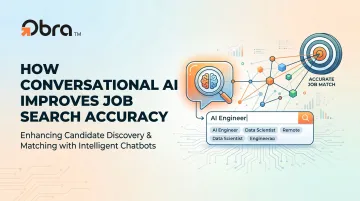
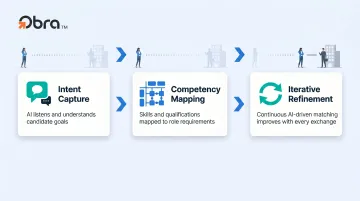
Conversational AI improves accuracy through three connected stages: intent capture, competency mapping, and iterative refinement. Each stage reduces the distance between what a candidate offers and what an employer actually needs.
Intent Capture
Traditional search forces job seekers to translate nuanced preferences into keywords — a process that consistently loses meaning. "Flexible work" and "remote" aren't the same thing. "Leadership role" and "people manager" aren't either. Conversational AI asks clarifying questions that surface actual preferences, including soft criteria like culture, growth trajectory, and industry adjacencies that keyword fields don't support.
The performance gap is measurable. In a peer-reviewed study from the ACM Conference on Recommender Systems, dialogue-based models achieved a Recall@10 of 0.6600 compared to 0.1806 for keyword-heavy knowledge-graph methods — a 3.6x improvement in surfacing relevant results through interactive dialogue.
Competency Mapping
Once intent is captured, the system maps stated skills and experience to actual job requirements using NLP and structured competency taxonomies. This is the technical step that separates competency-based matching from keyword co-occurrence.
Obra Hire's approach illustrates how this works in practice. Rather than scanning resume text for keyword matches, the platform uses structured competency data to determine candidate fit — displaying clear breakdowns of "Must Have" and "Nice to Have" criteria, showing exactly where a candidate matches or falls short.
The platform's SkillsTree taxonomy covers 8,241+ skills with proficiency levels, enabling matching at the level of demonstrated capability across blue-collar, gray-collar, and white-collar roles alike.
This matters because companies prioritizing skills-based searches are 12% more likely to secure high-quality talent, according to LinkedIn's Future of Recruiting 2025 report.
Iterative Refinement and Match Output
Conversational AI systems use engagement signals — which results a candidate clicks, what they dismiss, what follow-up questions they ask — to refine future outputs. A single-pass keyword search returns the same results whether or not you found them useful. A conversational system gets more accurate over time.
The practical output also looks different:
- Fewer listings, but higher relevance
- Applications aligned to specific role requirements
- A clearer articulation of why a candidate fits — not a broad resume sent to every open position
The impact on outcomes is direct. Tailored resumes receive twice the callbacks of generic ones. 20% of hiring managers consider a non-customized resume an instant deal-breaker. Getting the match right upstream means fewer wasted applications — and more interviews that actually convert.
Where Conversational AI Fits in the Job Search Process
Job Discovery
Conversational AI surfaces roles based on what a job seeker actually describes wanting — not just job title matches. On Obra Jobs, the platform collects behavioral data (jobs searched, clicked, applied to) alongside stated preferences (desired title, work schedule, experience level, pay range) to generate personalized AI recommendations and gap analysis feedback. This reduces time spent filtering irrelevant results and increases the proportion of genuinely applicable opportunities.
With 3M+ job listings across 34 industries, accurate filtering matters fast. Job seekers who rely on keyword searches alone spend most of their time sorting noise. Obra Jobs does that filtering automatically, using both what candidates say they want and how they actually behave on the platform.
Application Alignment
Conversational AI tools can walk candidates through how to align a resume to a specific role's actual requirements — not by rewriting it generically, but by identifying gaps, emphasizing relevant competencies, and flagging language that improves ATS visibility for that particular posting.
Obra Jobs offers this through personalized gap analysis: the system compares a job seeker's profile against job requirements and surfaces suggested adjustments, additional information to include, and alternative roles where qualifications may be a stronger match. The key distinction from auto-generated documents is specificity — the feedback is tied to a particular job, not a generic template.
Employer and Platform Side
Conversational AI also operates on the recruiter side. Obra Hire gives hiring managers three ways to search:
- Natural language description — describe the role in plain terms
- Job description paste — drop in an existing JD and let the engine parse it
- Manual filtering — build queries by selecting specific criteria directly
The "Must Haves vs. Nice to Haves" framework forces recruiters to distinguish essential qualifications from preferred ones, which produces more accurate candidate pools from the start.
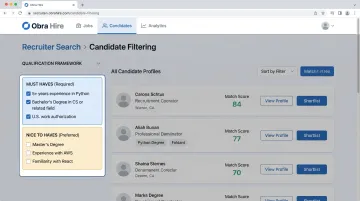
The candidate pool preview feature adds a feedback loop: teams can see estimated pool size and preview profiles before spending any credits, allowing them to validate and refine criteria before committing. This is how the system gets smarter about what the role actually requires, beyond what's written in the job description.
On recruiter efficiency: companies whose recruiters use AI-assisted tools most frequently are 9% more likely to make a quality hire, and recruiters using generative AI report saving an average of 20% of their work week.
Interview Preparation
Conversational AI interview simulators adapt questions based on candidate responses — pivoting from technical to behavioral questions, identifying vague answers, and reflecting the actual conversational dynamics of a real interview. Static question lists can't do that.
Obra Jobs' interview support currently focuses on facilitating actual interviews (scheduling, video conferencing) rather than AI-powered practice simulation. For adaptive interview prep specifically, third-party simulation tools pair well with the platform's job matching and gap analysis capabilities.
What Conversational AI Still Can't Do
Authenticity and Human Connection
Conversational AI cannot replicate genuine enthusiasm for a specific company. Cover letters and interview answers built entirely on AI-generated output are frequently flagged by recruiters as generic.
According to Resume Genius's 2026 Hiring Insights Report, 80% of hiring managers say they can often tell when a resume was written by AI, and 77% report seeing many resumes that appear fully or partially AI-generated.
The accuracy gain from AI matching must be paired with human personalization to convert a match into a hire. AI identifies what to emphasize — the candidate still has to make the case for why they want the role.
Judgment and Cultural Context
Conversational AI works from data it's trained on and inputs it receives. It cannot assess organizational culture fit, read non-verbal cues, or account for the unwritten criteria that many hiring decisions hinge on.
Research from UC Berkeley Haas found that "perceptual congruence" — how well an employee reads and adapts to organizational culture — is a stronger predictor of work performance than values alignment. Over 50% of hiring managers identify culture fit as their most important hiring criterion. None of that is captured in a job description or a competency taxonomy.
ATS Over-Optimization
Job seekers who use conversational AI primarily to stuff keywords for ATS may produce resumes that clear automated screening but read poorly to the human reviewer. Recruiters spend only 6–8 seconds on an initial resume scan. A resume optimized entirely for machine parsing often reads as exactly that.
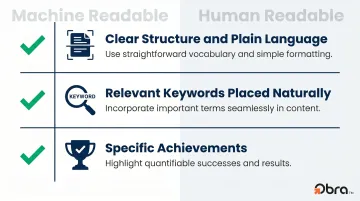
A strong resume passes both filters. That means:
- Clear structure and plain language that humans can scan in seconds
- Relevant keywords placed naturally — not stuffed into a skills block
- Specific achievements, not AI-patterned summaries, that give reviewers something to act on
Frequently Asked Questions
Can ATS detect ChatGPT?
Increasingly, yes. Resume Genius's 2026 Hiring Insights Report found that 80% of hiring managers say they can often identify AI-written resumes, citing generic phrasing, lack of specific achievements, and uniform sentence structure as common signals. AI-assisted drafting is fine; submitting unedited AI output is the risk.
What is the difference between conversational AI and a standard job search tool?
Standard job search tools process a static query (keywords, title, location) and return fixed results. Conversational AI engages in dialogue, asks clarifying questions, and refines outputs dynamically. The key difference is interactive refinement versus one-pass retrieval.
Does conversational AI replace the need to tailor your resume for each job?
No. Conversational AI can identify what to adjust — gaps, relevant competencies, ATS language — but the actual tailoring still requires human input. Specific achievements, quantified outcomes, and authentic voice still come from you.
How does conversational AI help with job matching accuracy specifically?
It captures preferences through dialogue rather than keyword input, maps them to structured competency frameworks, and refines results based on feedback. This reduces both false positives — roles that look right but aren't — and false negatives that a keyword search would miss entirely.
Can conversational AI help job seekers outside of tech or white-collar roles?
Yes. The underlying mechanism — intent capture and competency mapping — applies across all job categories. Platforms like Obra Jobs that cover 34 industries and include roles from CDL drivers to electricians to healthcare workers demonstrate that skills-based matching works regardless of collar category.