Introduction
Recruiters today face a paradox: more applications than ever, yet qualified candidates remain elusive. According to iCIMS, applications per job opening rose 19% year-over-year as of December 2024 — while actual hiring dropped 14% over the same period. More volume, fewer hires — and the problem isn't a talent shortage. It's a broken matching process.
The financial stakes are real. The U.S. Department of Labor estimates a bad hire costs at least 30% of that employee's first-year salary. Scale that across an organization making dozens of hires annually, and the losses compound fast.
The root cause is structural. Traditional matching was built for a different era — one with manageable application volumes and limited data. Keyword scanning and gut-level recruiter judgment worked when 20 people applied for a role. They fall apart at 200.
This guide covers what AI job matching actually does, where traditional methods fail, and what separates a capable platform from a superficial one.
TL;DR
- AI job matching uses machine learning and NLP to evaluate candidates on skills, experience depth, and role context — not resume keywords.
- Standardized, multi-factor scoring replaces inconsistent human screening — every candidate evaluated on the same criteria.
- Accuracy improves through competency-based matching, semantic understanding, and feedback loops trained on real hiring outcomes.
- Outbound AI platforms like Obra Hire proactively surface pre-vetted candidates rather than waiting for inbound applications.
- The measurable results: faster shortlisting, fewer mis-hires, lower cost-per-hire, and more consistent quality of hire.
What Is AI Job Matching?
AI job matching uses machine learning algorithms and natural language processing to compare candidate profiles against job requirements and predict fit strength. It goes well beyond matching a job title to a resume title, or checking whether a keyword appears in the right section.
What It Is Not
Many recruiters conflate AI job matching with two tools they already use:
- ATS keyword filters — binary pass/fail checks for specific terms
- Job board search — text-based queries against self-reported profile fields
Both operate on surface-level text. AI job matching evaluates meaning — understanding that "led cross-functional sprints" and "Agile project management" describe the same capability, even when the words don't match. That semantic gap is exactly the problem traditional tools leave unsolved.
Why It Exists
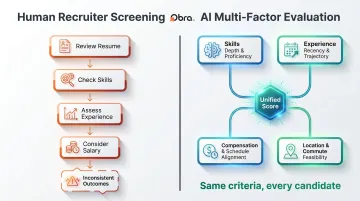
Human recruiters cannot evaluate dozens of contextual signals simultaneously at scale. Consider everything a role actually requires:
- Skills depth and demonstrated proficiency
- Experience recency and career trajectory
- Salary alignment and schedule compatibility
- Location feasibility and commute range
A recruiter reviewing 300 applications cannot weigh all of these consistently across every candidate. AI applies the same multi-factor evaluation to every profile in the pipeline — no fatigue, no shortcuts, no inconsistency.
SHRM Labs reports that 86.1% of recruiters using AI say it accelerates the overall hiring process, and 85% of employers report significant time savings.
Why Traditional Job Matching Falls Short
The Keyword Problem Runs Deep
A 2021 Harvard Business School study found that 94% of executives acknowledge their ATS filters out qualified candidates who would have been great hires — and 32% say this happens consistently, not occasionally. The system nearly 75% of employers rely on is, by their own admission, losing good people.
Two dynamics drive this:
- Candidates describing the same skill differently get filtered out because their vocabulary doesn't match the job description's vocabulary
- Candidates who understand how filters work can keyword-stuff resumes to pass screening without the underlying capability
Nearly half of companies automatically screen out any resume with a six-month or longer work gap — regardless of whether the candidate otherwise meets every requirement.
Recruiter Inconsistency Is Structural
Ask three recruiters to review the same 50-candidate pool and you'll get three different shortlists. Research published in Organization Science (2023) documented a systematic misalignment between what candidates emphasize and what recruiters prioritize — with individual recruiters applying different mental models to the same evidence. One weighs tenure, another weighs certifications, a third follows instinct.
This makes hiring quality person-dependent rather than process-dependent. When a great hire happens, it's often luck of the draw on which recruiter reviewed which application.
Hidden Deal-Breakers Surface Too Late
Shift incompatibility. A commute that looks reasonable on a map but isn't. Salary expectations 20% above budget. Physical demands the candidate didn't anticipate.
These factors routinely surface after a hire is made — contributing directly to the 33% of new hires who quit within their first 90 days. Traditional screening doesn't probe for these mismatches until it's too late.
How AI Job Matching Works
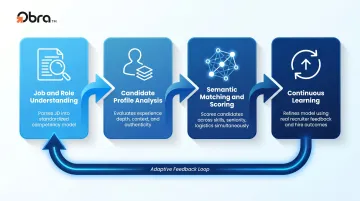
AI job matching runs as a sequence of layered processes, each adding signal clarity to the match. Here's how the process runs from job description to ranked candidate list.
Job and Role Understanding
The process starts before a single candidate is evaluated. The AI parses the job description to extract structured role context: job level, domain, required competencies, seniority indicators, and working conditions. The goal is to understand what the role actually requires, not just the specific words the employer chose to write.
Modern systems map job descriptions to standardized competency frameworks. The U.S. Department of Labor's O*NET database covers 900+ occupation profiles across more than 55,000 jobs, providing a foundation for translating varied job descriptions into standardized requirement sets.
This means two companies posting different-sounding descriptions for the same function get evaluated against the same underlying competency model — consistent scoring regardless of how individual employers phrase their listings.
Candidate Profile Analysis
AI reads candidate profiles at a level of depth that goes beyond listed skills. It parses experience context : industries, scale of work, tools and equipment, and how responsibilities evolved over time. This prevents title-match errors: two candidates both listed as "machine operator" can have very different actual experience, and AI can surface that difference.
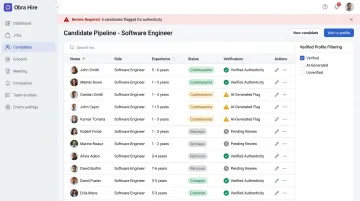
One growing challenge: AI-generated and fake candidate profiles inflating pipeline numbers. A Beamery survey found 46% of job hunters now use generative AI in their application process, and 53% of recruiters identify an AI-generated CV as their top red flag — surpassing job-hopping. Leading platforms address this with verification layers that confirm profile authenticity before candidates enter the matching pool. Obra Hire's Verified Profile Filtering feature, available on Explore and Scale plans, is designed specifically for this purpose.
Semantic Matching and Scoring
Semantic matching is where AI delivers its clearest advantage over keyword systems. Using NLP vector embeddings, the AI identifies that a candidate who "led cross-functional sprints in a SaaS environment" aligns with a role requiring "Agile project management" — without requiring identical terminology.
Candidates are scored simultaneously across multiple parameters:
- Skills overlap and depth
- Experience duration and recency
- Seniority alignment
- Career progression patterns
- Practical factors: location, schedule, compensation alignment
Obra Hire takes this further with competency-based matching — structured competency data rather than resume text — with each result showing a clear breakdown of where a candidate meets "Must Have" requirements versus "Nice to Have" preferences.
Continuous Learning and Feedback Loops
AI matching systems that incorporate recruiter feedback improve over time. As recruiters advance, reject, and ultimately hire candidates, the model learns what "good fit" looks like for that specific organization and role type — refining future scoring to reflect actual outcomes, not just initial profile similarity.
This feedback loop is what separates adaptive AI matching from static filtering tools. Without it, even a sophisticated system drifts toward the same limitations as the keyword filters it was meant to replace.
Key Ways AI Improves Job Matching Accuracy
Skills-Based Over Keyword-Based Evaluation
AI evaluates what a candidate can demonstrably do — cross-referencing experience depth, certifications, project context, and tools used — not how well they wrote their resume. The impact on candidate pool access is significant.
LinkedIn's March 2025 research found that skills-based hiring could expand global talent pools by 6.1x, and by 15.9x in the United States specifically. For AI roles, the pipeline increase reaches 8.2x. Those numbers reflect a structural shift in who gets seen, not just incremental improvement.
Consistent, Bias-Resistant Screening
AI applies identical evaluation criteria to every candidate regardless of name, school prestige, employment gap framing, or location description. This removes subjective variation from shortlisting. One recruiter's instinct doesn't determine whether a qualified candidate advances.
This benefit requires responsible model design, though. AI trained on historically biased hiring data replicates that bias at scale. The EEOC has issued technical guidance making clear that employers are legally responsible for algorithmic hiring outcomes — whether the tool was built in-house or purchased. Best-practice platforms remove protected attributes from matching inputs and run ongoing fairness monitoring.
Multi-Factor Simultaneous Evaluation
AI's accuracy advantage comes from evaluating many factors simultaneously. A recruiter prioritizing skills can still overlook a shift incompatibility or a missing certification. AI catches all of it in one pass.
This matters most for roles with complex, intersecting requirements:
- Healthcare: credential verification, licensing, specialty alignment, shift schedules
- Logistics: CDL class, equipment certifications, geographic coverage, hours-of-service rules
- Manufacturing: physical demands, equipment proficiency, safety certifications, plant location
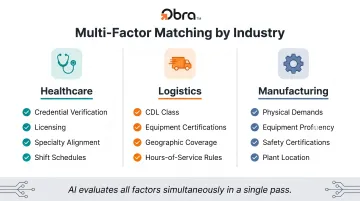
Obra Hire's platform searches across 800M+ profiles using this multi-factor approach — and allows recruiters to preview the matching candidate pool and its size before spending a single credit.
Outbound Matching vs. Passive Inbound Screening
Most hiring tools — traditional and AI alike — focus on screening who applies. Outbound AI matching inverts this: proactively identifying pre-vetted candidates from large databases before a role is even publicly posted.
The quality difference is structural. Inbound screening limits your pool to whoever happened to see the posting and apply that week. Outbound matching searches the full available talent landscape based on competency fit — surfacing ranked candidates who may be the strongest fits but would never have entered an inbound pipeline.
Quality of Hire as the Measurable Outcome
Every accuracy improvement described above connects to downstream hiring metrics. Glassdoor research suggests that optimized hiring processes can produce up to a 70% improvement in quality of hire. SHRM Labs reports AI-enabled recruiting can reduce cost-per-hire by as much as 30%.
The downstream signals that quality-of-hire tracking reveals:
- Reduced early-stage turnover (the 90-day quit rate)
- Faster productivity ramp in new hires
- Fewer backfills within the first year
- Higher hiring manager satisfaction scores
What to Look for in an AI Job Matching Platform
Not every platform marketed as "AI-powered" delivers equivalent matching accuracy. Three factors separate capable platforms from superficial ones.
Competency Depth vs. Keyword Surface
Look for platforms that match on standardized skill taxonomies with proficiency levels — not keyword presence. The distinction matters because two candidates can both list "Python" while one learned it in a bootcamp exercise and the other built production ML pipelines with it. A keyword match treats them identically. A competency-based match does not.
Obra Hire uses structured competency data with a "Must Haves" and "Nice to Haves" framework, evaluating actual skill fit rather than vocabulary overlap.
Verified Candidate Data and Fake-Profile Filtering
Nearly half of job seekers now use AI tools in their application process — meaning your match is only as good as the underlying profiles. AI-generated applications are the #1 red flag for 53% of recruiters.
Any platform without fraud detection is matching against a pool that may include significant synthetic or misleading data.
Prioritize platforms with identity verification and AI-generated profile filtering built into the matching pipeline — not offered as an afterthought.
ATS/HRIS Integration and Workflow Compatibility
Strong AI matching still creates friction if it doesn't connect to your existing infrastructure. Obra Hire integrates with 85+ ATS and HRIS platforms, including:
- Workday, Greenhouse, and iCIMS
- Lever, SAP SuccessFactors, and SmartRecruiters
- Oracle Recruiting Cloud
AI-matched candidates flow directly into existing hiring workflows without displacing them.
Frequently Asked Questions
How is AI job matching different from keyword-based resume screening?
Keyword screening checks for exact word matches: no term, no match. AI job matching uses semantic understanding and competency analysis to evaluate what a candidate can actually do — capturing qualified candidates who describe their skills differently and filtering out those who keyword-stuff without the underlying capability.
Can AI job matching reduce hiring bias?
AI can reduce bias by applying consistent criteria across all candidates, but only when responsibly designed. Models trained on historically biased data replicate that bias at scale, so best-practice platforms remove protected attributes from matching inputs and run ongoing fairness monitoring to catch disparate impact early.
How does AI handle fake or AI-generated candidate profiles?
Leading platforms use profile verification layers to confirm identity and filter synthetic or fraudulent profiles before they enter the matching algorithm. Obra Hire's Verified Profile Filtering addresses this directly by removing AI-generated profiles that inflate pool counts without representing real, contactable candidates.
What is competency-based matching and how does it differ from skills-keyword matching?
Skills-keyword matching checks whether a term appears in a profile. Competency-based matching evaluates whether a candidate has demonstrated proficiency at a defined level within a structured skill taxonomy, separating those who listed a skill from those who have genuinely applied it.
Does AI job matching work for industries beyond tech?
Yes, and the accuracy gains are often greatest outside tech. Roles in healthcare, logistics, and manufacturing carry multi-factor requirements (certifications, physical demands, shift schedules, equipment proficiency) that are hardest for manual screening to evaluate consistently at scale. AI handles these intersecting signals in a single pass.
How long does it take for an AI matching system to improve its accuracy over time?
Well-designed systems with active recruiter feedback loops typically begin refining match quality within weeks. The gains compound from there: each completed hiring cycle adds signal, making subsequent matches progressively more accurate. Volume and model design determine how fast that improvement curve steepens.