Introduction
The average job opening now receives 242 applications, yet industry estimates suggest roughly two-thirds to three-quarters of applicants don't meet the core qualifications for the roles they target. That mismatch doesn't just waste recruiter time — it produces bad hires, and bad hires are expensive. SHRM puts the upper-end cost at $240,000 per bad hire when you factor in recruitment, lost productivity, and turnover.
Most of these failures are preventable. Vague job descriptions, qualification lists with no weighting, and screening that relies on gut feel rather than structure are the usual culprits — and all three are fixable.
Here, you'll find a five-step matching process, a breakdown of what actually constitutes a true candidate match, the most common mistakes hiring teams make, and a look at when manual evaluation isn't enough on its own.
TL;DR
- Break job requirements into must-haves vs. nice-to-haves before reviewing any candidates
- Evaluate skills, experience, behavioral signals, and environment fit — not just titles and keywords
- A scoring rubric reduces bias and creates consistent, defensible decisions across your candidate pool
- Most matching failures trace back to vague JDs, equally-weighted qualifications, or keyword-only screening
- AI-powered outbound tools match on competency depth rather than resume text — valuable at high volume or broad sourcing scope
How to Match Candidate Qualifications to Job Requirements
Step 1: Deconstruct the Job Description Into Tiers
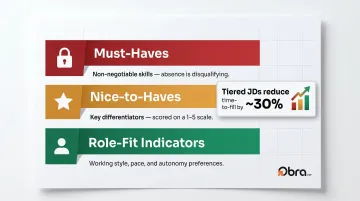
Before reviewing a single resume, restructure the job description into three tiers:
- Must-haves — Non-negotiable requirements. Absence is disqualifying.
- Nice-to-haves — Differentiators that strengthen a candidacy but aren't deal-breakers.
- Role-fit indicators — Working style, pace tolerance, autonomy needs, collaboration patterns.
Most job descriptions collapse these into a single flat list — 12 bullet points, all apparently equal. That's where mismatch begins. When recruiters can't tell which requirements are truly non-negotiable, they either over-filter (rejecting candidates who lack a nice-to-have) or under-filter (advancing candidates missing something critical).
A clear, tiered JD also narrows the talent pool to relevant candidates from the start. Research on accurate job descriptions found that organizations that cleaned up their JDs reduced time-to-fill by nearly 30% and improved candidate fit from 55% to 80%.
Step 2: Build a Candidate Evaluation Rubric
A rubric converts subjective impressions into comparable, defensible data points. Without one, two recruiters reviewing the same candidate often reach different conclusions — human inter-rater reliability sits at just 60–70%, compared to 85–95% consistency for structured evaluation methods. Structure yours around the three tiers:
- Must-haves: Binary pass/fail. Missing any = exit the process.
- Nice-to-haves: Scored (1–5 scale). Present and demonstrated = 5; claimed but uncontextualized = 2.
- Fit signals: Qualitative assessment tied to specific role requirements (autonomy level, pace, collaboration style).
Rubrics also protect against unconscious bias. A 2024 study across 97 U.S. employers confirmed that Black names still receive the fewest callbacks in the hiring process. Anchoring evaluation to predefined, role-relevant criteria reduces the influence of name, school prestige, or resume formatting on the outcome.
Step 3: Review Candidate Profiles Systematically
Order matters. A fixed review sequence prevents fatigue-driven inconsistency:
- Check must-haves first — disqualify anyone who doesn't meet them before reading further
- Score preferred qualifications — apply your rubric to remaining candidates
- Assess fit signals — look for patterns: scope of ownership, pace of environments, cross-functional exposure
Without a fixed sequence, early candidates get disproportionate scrutiny and later candidates benefit from reviewer fatigue. This applies whether you're evaluating inbound applications or candidates sourced proactively through outbound platforms.
Step 4: Score and Rank the Shortlist
Convert rubric scores into a ranked list. The ranking should reflect overall weighted scores — not recency of review or the reviewer's subjective impression of who "seemed strong."
Before scheduling interviews, loop in the hiring manager to validate the top-ranked candidates. This alignment step matters more than most teams realize:
- Mismatches between recruiter and hiring manager definitions of "qualified" are the most common reason candidates pass screening and fail interviews
- A quick calibration call at this stage catches those gaps before they waste interview time
Step 5: Flag Gaps and Decide on Acceptable Trade-offs
Perfect matches are rare. The real judgment call is whether a qualification gap is bridgeable or role-critical.
| Gap Type | Decision |
|---|---|
| Missing a nice-to-have skill | Advance — coachable or certifiable |
| Missing a must-have skill | Do not advance — strong soft skills don't offset this |
| Missing domain experience | Evaluate whether the learning curve is acceptable |
| Missing a preferred certification | Advance if demonstrated proficiency exists |
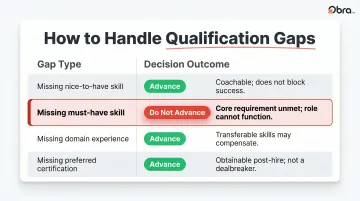
All must-haves must be present. Every other gap is a trade-off worth discussing — not a reason to stall the process.
Key Factors That Determine a True Candidate Match
Matching isn't one-dimensional. A candidate who looks right on paper may fail in practice if the evaluation only captures keyword overlap or job title history.
Technical Skills and Certifications
Hard skills need to be evaluated for presence and proficiency level — not just keyword mention.
86% of hiring managers say AI makes it too easy to exaggerate skills on resumes, and 80% say candidates' resumes don't match real-world abilities at least some of the time. A certification listed without context is a much weaker signal than a role where that skill was applied to a specific, relevant problem.
Keyword matching can't catch this distinction. It sees the word "Salesforce" whether someone administered an enterprise CRM for three years or completed a 4-hour introductory course.
Relevant Experience and Career Trajectory
Years of experience is one of the weakest predictors of job performance. What matters more:
- Complexity of problems solved — not just industry or tenure
- Scope expansion across roles — growing responsibility signals adaptability
- Relevant domain exposure — transferable context, not just adjacent titles
- Progression vs. lateral moves — consistent advancement reads differently than repeated sideways moves without scope change
BCG research found that a skills-based hire is five times more likely to predict job performance than one based on education credentials. Career trajectory read through a competency lens tells a richer story than title history alone.
Soft Skills and Behavioral Indicators
Soft skills can't be read directly from a resume — they have to be inferred from context or validated through structured behavioral questions.
Look for contextual signals:
- Cross-functional ownership (worked across teams, not just within one function)
- Leadership mentions with defined scope (managed X people, led Y initiative)
- Ambiguous problem-solving examples (built something from scratch, navigated a transition)
Behavioral alignment to the role environment matters as much as the technical match. A fast-moving startup role and a compliance-heavy enterprise role may share the same title but require entirely different behavioral profiles.
Culture and Role Environment Fit
Culture fit is not demographic similarity. It refers to alignment between how someone works best and what the role actually demands:
- Autonomy vs. direction — does the role require self-direction or does it operate within defined structures?
- Collaborative vs. independent — what does the team's working model look like day-to-day?
- Structured vs. ambiguous — how defined are the success criteria and processes?
Culture fit assessments can become a source of bias when "fit" is defined by personal affinity rather than observable work patterns. That distinction matters: skills-based hiring has been shown to increase female representation in underrepresented roles by up to 24%, meaning a shift toward competency evaluation improves both match accuracy and equity outcomes at the same time.
What You Need Before You Start Matching
Your matching process is only as good as its inputs. A vague JD and an unverified candidate pool will produce poor matches regardless of how structured your evaluation is.
A Clear, Tiered Job Description
A match-ready job description has:
- Defined must-haves (specific, not aspirational)
- Explicit seniority expectations (not just a title)
- A description of the work environment and success criteria
- Role-fit indicators distinct from the skills list
Without this, matching becomes interpretation — and interpretation varies by reviewer.
A Verified, Relevant Candidate Pool
Matching is only meaningful when candidate data is accurate. Self-reported skills, AI-inflated resumes, and outdated profiles introduce noise that degrades every downstream step.
Outbound sourcing platforms address this before manual review begins. Obra Hire lets recruiters search 800M+ profiles using competency-based criteria and preview candidate pool size before spending any contact credits.
The platform's Verified Profile Filtering (available on Explore and Scale plans) removes AI-generated and fake profiles — a problem Gartner projects will affect 1 in 4 profiles by 2028. Previewing pool size and profile quality upfront also helps confirm that search criteria are well-calibrated before any manual review begins.
A Standardized Scoring Framework Aligned With the Hiring Manager
The evaluation rubric must be built with the hiring manager — not handed to them after the fact. What looks like a qualified candidate to a recruiter and what looks qualified to a hiring manager can diverge significantly when criteria haven't been discussed in advance.
This alignment conversation should happen before any profiles are reviewed, not after the shortlist is built.
Common Mistakes When Matching Candidates to Job Requirements
- Equal-weighting all requirements: When 15 criteria carry the same weight, candidates missing the two most critical ones still advance. Treat must-haves as disqualifying — that's what separates a structured process from a checkbox exercise.
- Matching on titles and keywords, not competencies: A "Marketing Manager" at a 5-person startup and one at a Fortune 500 share a title but not a competency level. Keyword matching can't surface that gap; competency-based evaluation can.
- Skipping hiring manager alignment: The most common reason candidates pass screening and fail interviews is that recruiters and hiring managers define "qualified" differently. Have that conversation before reviewing candidates, not after you've built a shortlist.
- Ignoring disqualifiers until the end: Reviewing a full candidate profile before checking must-haves creates sunk cost pressure. Once you've spent 15 minutes on a resume, it's harder to walk away on a basic gap. Check must-haves first.
Manual Matching vs. AI-Powered Tools: When to Use Each
Neither approach works in isolation. The right answer depends on volume, role complexity, and whether you're working from inbound applications or sourcing proactively.
| Scenario | Recommended Approach |
|---|---|
| Low-volume, highly specialized roles | Manual — nuanced judgment is worth the time |
| High-volume screening (50+ applications) | AI-assisted first pass, human final review |
| Proactive outbound sourcing | AI-powered platform with competency filters |
| Final candidate selection | Human judgment — always |
Manual matching deteriorates at scale. AI screening maintains 85–95% consistency versus 60–70% inter-rater reliability for human reviewers. At high volume, that consistency gap matters more than the speed difference.
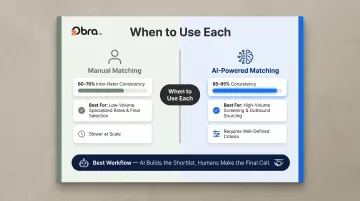
The practical trade-off: manual matching allows qualitative judgment but becomes slow and inconsistent above a certain volume. AI tools are fast and consistent but require well-defined criteria as input — if the job requirements are vague, AI matching just scales the vagueness.
Obra Hire addresses this by using structured competency data rather than resume text to evaluate candidates. The platform's Must Have / Nice to Have framework works in two tiers: must-haves determine who enters the pool, and nice-to-haves rank the results — mirroring the tiered evaluation structure described throughout this guide.
Recruiters building a pre-qualified pool before manual review can search, filter, preview, and reach out directly without waiting for inbound volume to accumulate.
The best workflow: use AI to build and rank a shortlist against well-defined criteria, then reserve human judgment for the final decision — where context, culture fit, and nuance actually matter.
Frequently Asked Questions
What is the difference between required and preferred qualifications in a job description?
Required qualifications are non-negotiable minimums — candidates who don't meet them shouldn't advance, regardless of other strengths. Preferred qualifications are differentiators that improve a candidate's profile but aren't disqualifying if absent. Conflating the two is one of the most common causes of mismatched hiring decisions.
How do you evaluate soft skills when matching candidates to job requirements?
Soft skills are best inferred from contextual signals in a candidate's history: cross-functional ownership, scope of leadership, examples of navigating ambiguity. Self-reported claims alone aren't reliable. Structured behavioral interview questions validate these signals before a final decision is made.
What is competency-based candidate matching?
Competency-based matching evaluates what a candidate can demonstrably do at what proficiency level, not whether a keyword appears on their resume. It's more accurate and more resistant to bias than title-based screening, and it surfaces qualified candidates that keyword-only filtering would overlook.
What should you do when a candidate meets most but not all job requirements?
The decision hinges on which requirements are unmet. If all must-haves are present, missing preferred qualifications is generally acceptable. If any must-haves are absent, strong soft skills or impressive credentials elsewhere shouldn't override the gap.
How can AI help recruiters match candidates to job requirements more accurately?
AI tools evaluate competency signals, career trajectory, and contextual indicators across thousands of profiles simultaneously, surfacing strong-fit candidates that keyword-only systems would miss. That said, AI still requires well-defined input criteria — vague or poorly structured requirements produce weak results regardless of the tool.
How do you reduce bias when evaluating candidate qualifications?
Anchor evaluation to a predefined rubric with role-specific criteria, and build that rubric with the hiring manager before any profiles are reviewed. Check must-haves first, before any qualitative assessment begins. Structured formats nearly double predictive validity compared to unstructured review, and they apply the same standard to every candidate.