Introduction
Most hiring teams today are drowning in data — candidate profiles, sourcing reports, application volumes — yet still making decisions based on intuition. The gap isn't data availability. It's data usability.
According to Korn Ferry's survey of 1,600 senior HR leaders, 99% say disconnected talent data hurts their bottom line, with fragmentation linked to up to a 29% profit impact. Meanwhile, global HR tech investment surged 60% year-over-year in 2025, signaling that companies know something needs to change.
This guide covers everything you need to make a smarter platform decision:
- What recruitment software with data management actually means
- The features that separate effective platforms from basic applicant trackers
- The metrics worth tracking
- How to choose the right tool for lean HR teams and high-volume recruiting operations alike
TLDR
- Recruitment software with data management goes beyond ATS — it centralizes, analyzes, and acts on hiring data across every funnel stage.
- Key features: centralized candidate databases, AI-powered matching, real-time analytics, data quality controls, and ATS/HRIS integration.
- Track time-to-hire, cost-per-hire, quality of hire, and source effectiveness — not just application volume.
- Faster decisions, lower sourcing costs, reduced early turnover, and stronger compliance records are the measurable gains.
- Top selection criteria: integration compatibility, data accuracy, scalability, and ease of adoption.
What Is Recruitment Software with Data Management?
Recruitment software with data management does more than track applicants through a pipeline. It captures, organizes, and puts to work hiring data across sourcing, screening, interviews, and offers — connecting activity to outcomes so teams can make faster, more consistent decisions.
The Evolution Beyond Basic ATS
First-generation applicant tracking systems were essentially digital filing cabinets. They stored resumes, logged applications, and moved candidates from one status to the next. That worked — until teams needed answers, not just records.
The shift to data management means connecting those records to what actually matters:
- Which sources produce hires who stay past 90 days
- Which screening criteria predict on-the-job performance
- Where candidates drop out of the funnel — and why
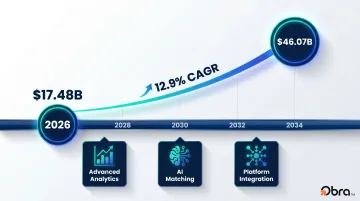
The market reflects this. Online recruitment technology is projected to grow from $17.48 billion in 2026 to $46.07 billion by 2034 at a 12.9% CAGR, according to Fortune Business Insights. That growth isn't driven by better resume storage — it's driven by analytics, AI matching, and platform integration depth.
Why "Data Management" Changes Everything in Recruiting
Reactive hiring means starting every search from scratch — no historical context, no insight into where sourcing spend actually worked, and no visibility into bottlenecks until candidates are already gone.
Data-managed hiring flips that model. Teams use living candidate databases, funnel analytics, and source performance data to anticipate needs, rediscover previously evaluated candidates, and eliminate redundant spend.
The core problem data management solves is fragmentation. When candidate records live in email threads, spreadsheets, and disconnected tools, no single person has a complete picture.
Gem's 2025 Recruiting Benchmarks report found that hires from CRM/ATS databases grew from 29.1% in 2021 to 44% in 2024. Centralized pipelines are becoming a primary hire source — not a fallback option.
Core Features That Define Efficient Recruitment Software with Data Management
Not all recruitment platforms manage data equally. These are the features that distinguish genuinely data-efficient platforms from basic applicant trackers.
Centralized Candidate Database
A centralized recruitment database indexes parsed candidate profiles — skills, experience, job titles — making every past applicant searchable and reusable. The practical benefit: rather than rebuilding sourcing from scratch for each new role, teams rediscover qualified candidates already in their system.
What to look for:
- Competency-based search (not just keyword matching)
- Duplicate detection to prevent inflated pipeline numbers
- Tagging and segmentation for role-based filtering
- The ability to move candidates from one role's pipeline to another
Obra Hire's database of 800M+ searchable profiles operates on this model. Teams can preview their candidate pool size before spending any credits — validating search criteria and confirming result quality before committing budget. That preview capability directly addresses one of the most common sourcing frustrations: wasted credits on searches with miscalibrated parameters.
AI-Powered Candidate Matching and Sourcing
A centralized database is only as useful as the search engine on top of it. Modern platforms score candidates against role requirements using competency and skills data — surfacing non-traditional candidates who wouldn't appear in a text-based search.
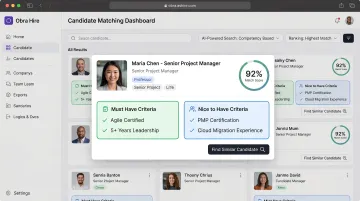
Obra Hire uses competency-based matching rather than resume keyword scanning. Each search result displays a clear breakdown of "Must Have" and "Nice to Have" criteria, showing exactly where a candidate aligns or falls short. Must Haves control who enters the candidate pool; Nice to Haves determine ranking within that pool.
The platform also includes a "Find Similar Candidate" feature (available on Explore and Scale plans) that expands shortlists by surfacing candidates with comparable competency profiles — useful for building bench depth on competitive roles.
Analytics Dashboards and Reporting
Most recruiting dashboards track activity. The better ones track outcomes.
- Vanity metrics: Application volume, page clicks, open rates
- Actionable analytics: Funnel conversion rates by stage, source yield, time-in-stage, recruiter output
SHRM has consistently emphasized that workflow conversion rates and time-in-stage data drive better hiring decisions than simple volume counts. A strong dashboard tells you where candidates are stalling — not just how many entered the funnel.
What to look for in analytics tools:
- Role and location-level filters
- Real-time data refresh (not weekly batch exports)
- Customizable KPI views for different stakeholders
- Export capability for existing BI tools
ATS/HRIS Integration Depth
Integration depth affects data management, not just workflow convenience. When recruiting data is siloed from payroll, performance, and HRIS systems, connecting pre-hire decisions to post-hire outcomes becomes nearly impossible.
Obra Hire integrates with 85+ ATS/HRIS platforms — including Workday, Greenhouse, iCIMS, Lever, and SAP SuccessFactors — allowing teams to add outbound sourcing and verified candidate data to their existing stack rather than replacing it. That's a meaningful distinction: most teams don't need a new ATS. They need better data flowing into the one they already have.
Integration checklist:
- Bidirectional data flow (not just one-way exports)
- Native support for your specific ATS/HRIS
- No requirement for a full platform replacement
Data Quality and Verification Controls
Fake profiles, AI-generated resumes, and outdated contact information degrade pipeline quality — producing numbers that look strong in reports but don't convert. Data quality controls are what separate a usable database from an expensive illusion.
Gartner has flagged that AI-generated profiles could affect 1 in 4 profiles by 2028. Obra Hire addresses this directly through Verified Profile Filtering (available on Explore and Scale plans), which filters search results to surface real, contactable candidates — not synthetic profiles that pass keyword screens but don't represent actual people.
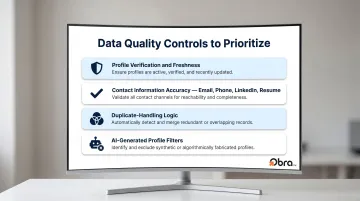
Data quality controls to prioritize:
- Profile verification and freshness indicators
- Contact information accuracy (email, phone, LinkedIn, resume)
- Duplicate-handling logic
- Filters for AI-generated and unverified profiles
Key Hiring Metrics Your Recruitment Software Should Track
Data management is only valuable when it tracks the right signals — metrics that connect hiring activity to business outcomes, not just process activity.
Speed and Volume Metrics
Time-to-hire measures the span from application to accepted offer. Time-to-fill measures from open requisition to filled role. Both matter for different reasons.
- Time-to-hire reflects candidate experience and pipeline efficiency
- Time-to-fill reflects workforce planning accuracy
Slow processes lose candidates. SHRM's 2025 Recruiting Benchmarking Report breaks both metrics down by industry and company size — a useful starting point for setting internal targets.
Offer acceptance rate signals something different. When acceptance rates drop, it usually means one of three things: compensation is misaligned, candidate communication broke down somewhere, or the process moved too slowly and candidates accepted competing offers. A CareerBuilder survey cited by SHRM found the top reasons for declined offers were receiving another offer (39%) and compensation misalignment (29%).
Quality and Cost Metrics
Cost-per-hire divides total recruiting spend by total hires in a period. SHRM's benchmark puts the average at $4,129 per hire — useful as a baseline reference when setting budgets, even as actual costs vary by role and industry. Recruitment data management makes this figure calculable by consolidating spend across job boards, recruiter time, and tool licenses rather than requiring manual spreadsheet reconciliation.
Quality of hire is the most strategic metric on this list — it asks how well new hires are performing and staying. Calculating it requires connecting pre-hire data (source, assessment score, interview rating) to post-hire outcomes like 90-day retention and performance review scores.
Most standalone ATS tools can't make that connection without HRIS integration, which is why integration depth matters so much when evaluating platforms.
Source Effectiveness and Early Turnover
Source-of-hire tracking answers which job boards, referral programs, and sourcing channels produce hires who stay longest and perform best. Optimizing your source mix based on outcome data — not application volume — is one of the clearest levers for reducing cost-per-hire over time.
Early turnover (departures within the first 90 days or first year) is a lagging indicator that surfaces misfires in the hiring profile or screening process. Work Institute's research found that over one-third of new hires leave within their first year, with ramp-to-productivity taking 8 to 24 months — making early attrition expensive. Recruitment platforms with data management connect early turnover rates back to specific sources, screeners, or assessment scores so the root cause is identifiable and addressable, not just visible in a dashboard.
Benefits of Using Data-Driven Recruitment Software
Ranked pools, clear funnel visibility, faster hires. When recruiters have ranked candidate pools, clear funnel visibility, and source performance data, second-guessing decreases. StaffingHub's 2025 research found that 55% of recruiters saw faster time-to-hire and 53% reported higher candidate quality after investing in AI-powered recruiting tools.
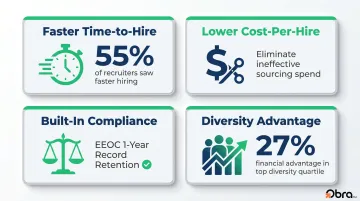
Lower cost-per-hire by cutting what isn't working. Data management surfaces which channels and processes are expensive without being effective. Teams that adjust their source mix based on yield data — rather than habit or vendor preference — consistently cut wasted budget.
Built-in compliance without the manual record-keeping. Centralized data creates an auditable record of hiring decisions. The EEOC requires employers to retain personnel and employment records for at least one year — a platform with structured data logs makes that straightforward.
The diversity case is equally concrete. McKinsey's 2023 research found that companies in the top ethnic diversity quartile show an average 27% financial advantage — making real-time pipeline diversity metrics a business case issue, not just a compliance one.
How to Choose the Right Recruitment Software for Your Team
Define Your Data Needs First
Before evaluating platforms, clarify what data you currently have, what's missing, and what decisions you need it to support. A team struggling with sourcing has different data needs than one struggling with early turnover.
Ask internally:
- What metrics are we not tracking today?
- Where in the funnel do we consistently lose candidates?
- Are we making sourcing decisions based on outcome data or habit?
- Do we have a way to connect pre-hire decisions to post-hire performance?
The answers will point you toward whether you need sourcing infrastructure, analytics depth, HRIS integration, or some combination.
Evaluate Integration Compatibility Over Feature Lists
The best recruitment software for your team connects to your existing ATS, HRIS, or payroll system without requiring a platform overhaul. A tool with strong standalone features but poor integration depth will create another data silo — fragmenting the candidate data you're trying to unify.
Obra Hire integrates with 85+ ATS/HRIS systems including Workday, Greenhouse, iCIMS, Lever, and SAP SuccessFactors. For teams with an existing ATS workflow, that means layering outbound sourcing and verified candidate data onto infrastructure that's already working.
Weigh Cost, Scalability, and Ease of Adoption Together
The highest-priced platform isn't always the most effective one. Consider:
- Per-user fees, credit models, implementation costs, and training time all factor into true ownership cost
- The platform should handle volume spikes without forcing a plan upgrade mid-cycle
- If recruiters and hiring managers find it cumbersome, adoption will stall regardless of features
Obra Hire's tiered model addresses this head-on. The Free tier (1,000 profile views + 50 contact credits/month) lets teams validate candidate pools before any financial commitment. The Explore plan ($109/month) serves occasional hiring managers. The Scale plan ($169/month) adds shared credits, centralized admin controls, and team collaboration for full-time recruiting teams.
Frequently Asked Questions
What is the best software for recruitment?
There's no single best platform for all teams. The right tool depends on team size, hiring volume, existing systems, and whether your priority is inbound tracking, outbound sourcing, or analytics. Obra Hire serves outbound sourcing and candidate discovery; tools like Greenhouse or Workable serve structured applicant tracking — and many teams use both in combination.
What is the difference between an ATS and recruitment software with data management?
An ATS tracks applicants through a pipeline. Recruitment software with data management goes further: it centralizes cross-platform hiring data, applies analytics to identify patterns, and connects pre-hire decisions to post-hire outcomes like retention and performance. A standalone ATS typically can't do this without HRIS integration.
What KPIs should recruitment software track?
Track time-to-hire, time-to-fill, cost-per-hire, offer acceptance rate, quality of hire, source effectiveness, and early turnover rate. Quality of hire deserves the closest attention — it directly ties sourcing and screening decisions to retention and performance outcomes.
How does recruitment software improve data quality in hiring?
Strong platforms include profile verification, deduplication logic, data freshness indicators, and AI-generated profile filters. Obra Hire's Verified Profile Filtering (available on Explore and Scale plans) specifically filters out fake and AI-generated profiles, ensuring recruiters spend time on real, contactable candidates.
How do I integrate recruitment software with my existing HR systems?
Most modern platforms offer integrations with major HRIS and ATS providers. Prioritize bidirectional data flow rather than one-way API exports, and confirm compatibility with your specific stack before purchasing. Obra Hire supports 85+ integrations, but confirming your exact ATS is on the compatibility list is worth doing upfront.
Is free recruitment software worth using for data management?
Free tiers, including Obra Hire's, are a practical starting point for smaller teams or those adding outbound sourcing alongside an existing stack. Deeper analytics, team collaboration, and broader integrations require paid plans, so treat the free tier as a proof-of-concept before committing.