
That's the standard experience when hiring for a niche role — a flood of generalist applicants who match on keywords but miss entirely on the specialized skills the position actually requires. Meanwhile, the role sits open for weeks, and the team absorbs the cost in overwork, delayed projects, and lost productivity.
According to ManpowerGroup's 2024 Global Talent Shortage report, 75% of employers globally report difficulty filling roles, with healthcare at 77% and IT close behind. This isn't a temporary condition — it's structural.
This article covers what actually works: switching to outbound sourcing, writing job descriptions that specialists respond to, targeting the right channels, and building referral programs that tap into existing expertise networks.
TLDR
- Most niche specialists are passive candidates — reach them through outbound outreach, not job postings.
- Precise, field-specific job descriptions filter in qualified candidates and filter out mismatches.
- Niche job boards and professional communities surface openings to already-qualified audiences.
- Referral programs and transparent compensation packages close the gap when talent pools are thin.
Why Niche Roles Are Harder to Fill Than They Should Be
The core problem isn't the job. It's the sourcing model.
Most niche specialists are already employed. They're not browsing Indeed on a Tuesday afternoon. LinkedIn data shows roughly 70% of the global workforce is passive — not actively job searching — yet 87% of both active and passive candidates are open to new opportunities. The talent exists. Standard inbound posting just doesn't reach it.
The Keyword Problem
Generic job postings attract generic applicants. When a niche role is written in broad, accessible language, it pulls in candidates who partially match on common keywords — "project management," "data analysis," "cross-functional teams" — but lack the specific technical depth the role demands. The result: high-volume, low-quality pipelines that eat recruiter time on screening work that leads nowhere.
The Brand Visibility Gap
Smaller organizations face an additional disadvantage. Well-funded competitors with established employer brands dominate the channels where specialist talent occasionally browses. A senior biostatistician or machine learning infrastructure engineer evaluating options will more likely encounter familiar names first — pushing lesser-known employers down the consideration list.
Reactive, inbound-only hiring is fundamentally at odds with how specialist talent behaves — which is why filling these roles demands a different approach to sourcing from the start.
Go Outbound: Proactively Source Niche Talent
Outbound recruiting means reversing the traditional model. Instead of posting and waiting, you search for candidates who match your criteria and initiate contact directly. Your team controls who enters the pipeline rather than leaving it to chance.
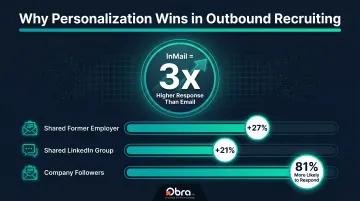
This approach consistently outperforms inbound for niche roles — it's not guesswork. LinkedIn's data shows InMail response rates average 3x higher than regular email, with personalization lifting response rates further — referencing a shared former employer adds 27%, a shared LinkedIn group adds 21%, and company followers are 81% more likely to respond to outreach.
Identify and Engage Passive Candidates
Outreach to passive candidates only works when it's specific. A message that reads like a mass blast gets ignored. One that references the candidate's actual experience, speaks to their technical domain, and explains why this particular role is worth their attention gets replies.
A few things that make specialist outreach land:
- Name the specific technology or methodology relevant to their background
- Reference a specific project or publication if their profile makes it visible
- Lead with what's compelling about the work, not just the job title
- Be brief — niche professionals are busy; respect that
Obra Hire's platform is built around this outbound model. Recruiters search across 800M+ verified candidate profiles using competency-based filters — "Must Have" criteria control which candidates enter the pool, while "Nice to Have" criteria rank results by fit quality. The AI accepts natural language, job descriptions, or manual filters, then surfaces ranked, skill-matched results.
Before spending any credits, teams can preview their candidate pool size and review individual profiles to confirm the search is returning the right results.
When a candidate is worth pursuing, a single "Reveal Contact" unlocks their email, phone number, LinkedIn URL, and resume.
Verify Candidate Quality Before You Invest Time
Finding the right candidate is only half the challenge — confirming they're real is the other. AI-generated and inflated profiles increasingly pollute candidate searches. Obra Hire's verified profile filtering — available on Explore and Scale plans — filters search results to surface verified profiles, reducing exposure to fraudulent candidates. For niche roles where credentials genuinely cannot be fabricated without consequences downstream, this matters.
Speed also matters. Niche candidates who are passively evaluating options don't stay available indefinitely. A streamlined process helps:
- Move to a screening call within 48 hours of identifying a strong match
- Communicate your timeline upfront — specialists disengage when the process feels undefined
- Limit interview rounds to what's necessary for the role level
- Keep feedback loops short — candidates read silence as disinterest
Write Job Descriptions That Actually Attract Niche Candidates
Generic language is a red flag to specialists. Phrases like "team player," "results-oriented," and "fast-paced environment" signal that the hiring team doesn't understand the role well enough to describe it accurately. Before drafting any niche job description, consult the person who currently does this work, or a subject matter expert who has.
Use Precise, Field-Specific Language
Niche candidates self-identify when they see their technical vocabulary reflected accurately. A clinical data manager recognizes the difference between a team that knows what CDISC CDASH means and one that's describing a vague "data organization" function. That vocabulary signals whether a role is worth their time.
Write to the candidate's competency level:
- Use industry-standard terminology for tools, frameworks, certifications, and methodologies
- Frame requirements around outcomes and capabilities, not just credentials
- Be direct about which qualifications are genuinely required versus preferred
On the qualification list specifically: HBR research by Tara Mohr found that many candidates — particularly women — interpret listed qualifications as strict requirements rather than guidelines, leading them to self-select out when they don't meet every item. Keep the "must-have" list to the 3–5 competencies the role truly cannot function without. Move everything else to a clearly labeled "preferred" section.
Sell the Role, Not Just the Requirements
Specialists with in-demand skills are actively evaluating your opportunity. A job description that reads like a requirements checklist misses the point.
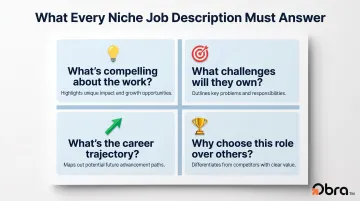
Address these four questions directly in the posting:
- What's compelling about the actual work? The problems, not just the title.
- What unique challenges will this person own? Niche candidates want real responsibility.
- What's the career trajectory? Specialists want to know where the role leads — not just what it requires.
- Why choose this role over a competing offer? Name one concrete reason this opportunity stands out from the others they're fielding.
On compensation: include a salary range. SHRM reports the share of postings with salary ranges jumped from 22% to 45% in a single year, driven by candidate demand for transparency. Many job seekers skip listings with no pay information entirely.
For niche roles with above-market pay, posting that number upfront filters in serious candidates and cuts screening time wasted on mismatched expectations.
Tap Niche Job Boards and Professional Communities
Industry-specific boards put your posting in front of candidates who have already declared themselves in a field — a fundamentally different starting point than a general board where anyone can apply.
| Board | Focus |
|---|---|
| Health eCareers | Healthcare employers and clinicians |
| eFinancialCareers | Finance, banking, buy-side, fintech |
| Dice | Technology and engineering professionals |
| SHRM Jobs | HR and people operations roles |
Job boards are only part of the picture. Post in the communities where specialists already spend time — LinkedIn groups, industry Slack workspaces, professional association forums, and trade organization channels. Many practitioners who would never search a job board will respond to an opportunity surfaced somewhere they already trust.
That same community presence extends to social media. Short culture posts, behind-the-scenes content, and employee spotlights build organic brand recognition before a vacancy opens — so when one does, you're already a known quantity.
Leverage Referrals, Your Network, and Competitive Compensation
Employee referrals consistently rank among the highest-quality sourcing channels. The reason they work especially well for niche roles is straightforward: your current specialists know other specialists. A senior embedded systems engineer has a professional network full of other embedded systems engineers — people whose competence they can personally vouch for.
Building a Referral Program That Works
A few structural elements make the difference between a referral program employees actually use and one that gets announced once and forgotten:
- Communicate open roles actively — don't assume staff will find postings on their own
- Create meaningful incentives: cash bonuses, additional PTO, public recognition, or a combination
- Keep submission simple — one-click referral links, minimal paperwork, clear status updates
- Acknowledge hires publicly when a referral leads to an offer
Compensation and Non-Monetary Levers
Once referrals surface strong candidates, the offer has to close them. Niche candidates rarely negotiate down, so research the market before posting. Tools like BLS Occupational Employment data, LinkedIn Salary, and industry-specific salary surveys give reliable benchmarks for specialized roles. Coming in below market on a first offer for a hard-to-fill role almost always means starting over.
Beyond base salary, specialists respond to:
- Remote or hybrid flexibility, consistently rated among the top non-monetary factors
- Professional development budgets — conferences, certifications, and training allowances
- Ownership over a domain, not just task execution
- A clear growth path: what does the next two years look like for someone excellent in this role?
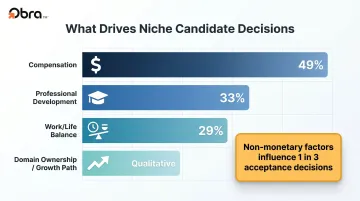
LinkedIn data shows compensation drives 49% of acceptance decisions, but professional development (33%) and work/life balance (29%) trail closely. For candidates weighing multiple strong offers, these levers can tip the decision.
Frequently Asked Questions
What is considered a niche job?
Niche jobs require highly specialized skills, credentials, or experience that significantly narrow the available candidate pool. Examples span many industries — nurse practitioners, AI infrastructure engineers, quantitative analysts, licensed electricians, and specialized attorneys all qualify as niche roles.
Why are niche roles so hard to fill?
Most niche specialists are passive candidates who are already employed and not actively applying. Standard inbound job posting rarely reaches them. Filling these roles consistently requires proactive outbound outreach to candidates who would never find the posting on their own.
Should I use a specialized recruiter or handle niche hiring in-house?
Both have merit. A niche recruiter brings industry relationships and domain vocabulary that can accelerate sourcing in unfamiliar fields. In-house outbound tools like Obra Hire offer more control and lower cost — especially for teams hiring similar roles repeatedly. Budget, timeline, and volume typically determine the right call.
How do I write a job description for a niche position?
A strong niche job description should:
- Use field-specific terminology throughout
- Separate must-have qualifications from preferred ones
- Include a compensation range
- Frame the role as a value proposition, not just a requirements list
Consult a subject matter expert before drafting if the role is outside your direct expertise.
What's the difference between active and passive candidates for niche roles?
Active candidates are currently job searching and will apply to open postings. Passive candidates — who make up the majority of niche specialists — are currently employed and satisfied enough not to be looking. Reaching them requires personalized outbound outreach, not job board visibility.