Introduction
More applications does not mean better candidates. In 2025, the average hire requires sifting through 291+ applications — triple the volume from just four years ago — and a growing share of those are AI-generated, mismatched, or outright fake. Gartner predicts that by 2028, 1 in 4 candidate profiles worldwide will be fake.
For hiring teams, the real challenge isn't attracting more applicants. It's choosing the right sources to consistently surface qualified candidates — before those roles stay open for 44+ days and cost thousands in lost productivity.
This guide breaks down the most effective recruitment sources available today — from internal promotions and employee referrals to outbound sourcing platforms — so you can build a source mix calibrated to your actual hiring goals, not just your applicant volume.
TL;DR
- Recruitment sources fall into two categories: internal (promotions, referrals) and external (job boards, agencies, outbound platforms)
- Employee referrals convert at 28.2% apply-to-hire — far above the 2–5% rate for job boards
- Broad inbound job boards generate volume, but signal quality is dropping as AI-generated applications flood the pipeline
- Outbound platforms like Obra Hire let you search 800M+ verified profiles proactively — no waiting for applications
- Tracking source-of-hire data is the only way to know which channels are actually worth your budget
What Are Recruitment Sources and Why Do They Matter
Recruitment sources are the specific channels and methods hiring teams use to identify and attract candidates. They fall into two categories:
- Passive (inbound) sources — job boards, career pages, social media ads — pull candidates toward you
- Active (outbound) sources — sourcing platforms, direct outreach, networking — push recruiters toward candidates
The distinction matters because passive sources have become increasingly unreliable as primary channels. According to SHRM's 2025 Recruiting Benchmarking Report, median time-to-fill sits at 44–45 days, climbing to 61 days at large organizations. Median cost-per-hire for executive roles has hit $10,625 — a 113% increase since 2017.
The wrong source mix inflates cost-per-hire, weakens your candidate pool, and creates bottlenecks that compound across every open role. Which sources you rely on shapes every downstream hiring outcome — from offer acceptance rates to time-to-productivity.
Top Recruitment Sources for Finding Quality Candidates
The following sources represent the most widely used and highest-performing channels across industries. Each has distinct strengths depending on role type, seniority, and urgency.
Internal Talent Pools and Promotions
Promoting or laterally transferring existing employees is one of the fastest and lowest-cost sourcing methods available. Internal candidates already understand company culture, require less ramp-up time, and signal to the broader workforce that growth paths exist.
LinkedIn's 2024 research shows employees at high internal mobility companies stay 60% longer and receive 79% more leadership promotions. Internal hires also reduce time-to-hire by 10–12 days compared to external sourcing.
That said, internal hiring has dropped to just 24% of all hires post-pandemic, and only 33% of organizations run formal internal mobility programs. Over-relying on promotions without backfilling mid-level roles creates its own talent gaps. This approach works best for known high-performers and culture-critical positions.
Employee Referral Programs
Referral programs are consistently the highest-converting sourcing channel available. The data reflects it:
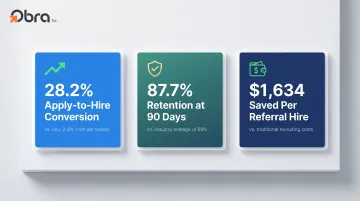
- 28.2% apply-to-hire conversion rate for referrals vs. 2–5% for job boards
- 87.7% retention rate at 90 days for referred hires
- Each referral hire saves approximately $1,634 in recruitment costs
The quality advantage comes from a simple dynamic: employees self-select who they recommend because their own reputation is on the line.
Best practices for structured referral programs:
- Tie the referral bonus payout to a milestone (90-day tenure, not hire date) to prevent low-quality submissions
- Set clear job criteria so employees know who qualifies before they refer
- Make submission easy — 47% of referrals happen outside business hours
Job Boards and Career Sites
Job boards fall into three categories, each serving a different audience:
| Board Type | Examples | Best For |
|---|---|---|
| Broad/general | Indeed, ZipRecruiter | High-volume entry-level roles |
| Professional network | LinkedIn Jobs | Mid-level professional roles |
| Niche/industry | Dice, Wellfound, Himalayas | Specialized technical or startup roles |
Matching the board to the role type matters more than board familiarity. A software engineering role posted on Indeed generates volume; the same role on a developer-specific board generates signal.
Job boards deliver 50% of applications but only 27% of hires, according to recent benchmarking data. Career site applicants, despite representing just 1.9% of total applications, convert at nearly 2x the rate of job board applicants.
The AI-generated application problem has made inbound quality worse. In Q4 2024, 39% of candidates reported using AI during the application process, including generating resume text and assessment answers.
LinkedIn and Professional Networks
LinkedIn serves two distinct functions: a job board for active seekers and a sourcing database for passive candidates via LinkedIn Recruiter. InMail response rates average 18–25%, with top campaigns reaching 35–40%.
Cost is the main friction point. LinkedIn Recruiter seats run approximately $8,990–$10,800 per year for the full corporate version, a significant line item for teams hiring across multiple roles.
For specialized hiring, niche professional networks often outperform LinkedIn on both quality and engagement:
- GitHub — engineering and open-source talent
- Behance — designers and creative professionals
- Wellfound (AngelList) — startup-focused roles
Social Media Recruiting
91% of U.S. employers now use social media for hiring. Candidates sourced via social are 8x more likely to be hired than those from traditional job boards. That figure reflects precise demographic targeting, not the platform itself.
Social media works best as a top-of-funnel awareness channel:
- Use LinkedIn, Facebook, and Instagram for paid job ad targeting toward specific demographics
- Use organic content and employee spotlights to build employer brand visibility
- Drive traffic to your career page rather than treating social as a primary screening tool
Use it to fill your pipeline, not as a precision screening tool.
Recruitment Agencies and Staffing Firms
Agencies make the most sense in specific situations: executive or highly specialized roles where internal sourcing capacity is limited, or urgent high-volume hiring where speed outweighs cost concerns.
Contingency fees typically run 15–25% of first-year salary, with 20% being the most common rate. On a $100,000 salary, that's a $20,000 placement fee per hire.
For teams hiring at scale across multiple roles simultaneously, that math compounds quickly. Many organizations are replacing agency reliance with self-serve sourcing platforms that provide comparable reach at a fraction of the cost. Tools like Obra Hire give hiring teams direct access to 800M+ candidate profiles without per-placement fees or third-party gatekeepers.
Company Career Page and Employer Brand
A well-maintained, SEO-optimized careers page is technically a zero-variable-cost channel once built, and it captures the highest-intent candidates: people who are already interested in working for your company specifically.
Employer brand amplifies the effectiveness of every other source. LinkedIn Talent Solutions data shows a strong employer brand delivers:
- 50% reduction in cost-per-hire
- 28% reduction in turnover
- 50% more qualified applicants
Glassdoor reviews, employee spotlights, and culture content do the filtering before candidates apply. Candidates who research your company and still apply are already pre-qualified on culture fit. Those who aren't interested self-select out — a built-in quality filter that no job board can replicate.
Outbound Sourcing Platforms: The Fastest Path to Verified Candidates
Inbound sourcing means waiting. You post a job, hoping the right candidates find it, apply, and aren't filtered out by ATS keyword mismatches or buried in a pile of AI-generated submissions. Outbound sourcing flips that model entirely: recruiters search proactively for qualified candidates and contact them directly.
Research shows 62% of talent teams find more high-quality candidates through outbound sourcing than inbound applications, and **70% of the global workforce is classified as passive candidates** — meaning the best candidates for most roles aren't browsing job boards at all.
What Modern Outbound Platforms Provide
Outbound sourcing platforms give hiring teams:
- Searchable databases of millions of candidate profiles
- AI-powered matching based on skills and competencies (not just keyword hits)
- Direct access to candidate contact information (email, phone, LinkedIn) without third-party gatekeepers
- Verified profile filtering to reduce exposure to fake and AI-generated profiles
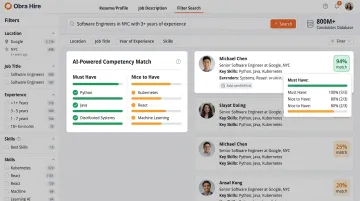
Obra Hire is one platform built specifically for this model. It provides access to 800M+ candidate profiles with AI-powered, competency-based matching. Rather than parsing resume text for keyword frequency, the system uses structured competency data. Recruiters can see exactly where a candidate meets "Must Have" criteria versus "Nice to Have" preferences — a distinction that cuts screening time significantly.
Preview Before You Spend
One of the more practical features of outbound platforms is the ability to validate before committing budget. With Obra Hire, recruiters can see their estimated candidate pool size and preview full profiles — including competency match breakdowns — before spending a single contact credit.
Credits are only consumed when you choose to reveal a candidate's contact details: email, phone number, LinkedIn profile URL, and resume. The free tier includes 1,000 profile views and 50 contact credits per month, which gives hiring teams enough room to test the platform against real open roles before upgrading.
Integration Without Disruption
The other practical consideration: outbound platforms only deliver value if recruiters actually use them alongside their existing workflows. Obra Hire integrates with 85+ ATS and HRIS platforms — including Workday, Greenhouse, iCIMS, Lever, and SAP SuccessFactors — so candidate data pushes directly into existing pipelines without requiring teams to rebuild their processes.
How to Choose the Right Recruitment Sources for Your Hiring Goals
Source selection should be driven by three variables:
- Role seniority — entry-level roles have different sourcing needs than specialized or executive positions
- Hiring urgency — immediate backfills need different channels than pipeline building
- Budget — agency-level spend per hire is not equivalent to self-serve platform economics
A simple decision framework:
| Scenario | Recommended Primary Source |
|---|---|
| Entry-level, high volume | Broad job boards + employee referrals |
| Mid-level professional | LinkedIn + outbound platform |
| Specialized/technical | Niche boards + outbound platform |
| Executive | Internal mobility first, agency if needed |
| Urgent backfill | Outbound platform + referral push |
| Pipeline building | Career page SEO + employer brand |
Track Source-of-Hire — Without Exception
Source-of-hire is identified by recruiting analysts as the single most important metric for aligning sourcing investment with actual placement outcomes. Without it, you're optimizing for applicant volume instead of hire quality.
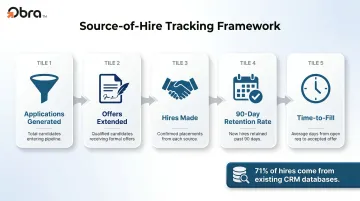
What to track per source:
- Applications generated
- Offers extended
- Hires made
- 90-day retention rate
- Time-to-fill
71% of hires come from candidates already in a firm's CRM database — not new inbound applications. Teams that track this data consistently find they're over-investing in channels that generate applications and under-investing in channels that generate hires.
That pattern points to the two most common sourcing mistakes: defaulting to a single channel regardless of role type, and choosing sources based on familiarity rather than performance data. Both are easy to fix once you're tracking the right numbers.
Conclusion
No single source reliably fills every role. The most effective recruiting functions combine internal mobility, structured referral programs, targeted external channels, and a proactive outbound method — calibrating the mix based on role type, not habit.
Obra Hire offers a free, no-contract starting point for teams that want to source proactively: search 800M+ verified candidate profiles, preview your candidate pool before spending any credits, and connect directly with your existing ATS. No setup required.
Frequently Asked Questions
What are the commonly used recruitment sources?
The most widely used sources are internal promotions, employee referrals, job boards (Indeed, LinkedIn), company career pages, social media, staffing agencies, and outbound sourcing platforms. Most organizations use a combination rather than relying on any single channel.
What is an example of targeted recruitment?
Targeted recruitment means sourcing from a specific channel matched to the role. For example, a recruiter filling a specialized engineering position might search Obra Hire and filter by skills, location, and seniority level rather than posting broadly and screening high volume.
What is the difference between internal and external recruitment sources?
Internal sources draw from your existing workforce — promotions, lateral transfers, and employee referrals. External sources bring in candidates from outside the organization through job boards, staffing agencies, outbound platforms, or social media.
Which recruitment source tends to produce the highest quality candidates?
Employee referrals and outbound sourcing consistently rank highest for candidate quality and retention. Broad inbound job boards generate higher volume but require significantly more screening to identify qualified fits.
How do outbound sourcing platforms differ from job boards?
Job boards are passive: you post and wait for applications. Outbound platforms like Obra Hire let recruiters proactively search verified profiles, apply competency-based filters, and contact candidates directly without waiting for them to apply.
What is the most cost-effective recruitment source for growing teams?
Employee referrals carry the lowest cost-per-hire but don't scale well. Self-serve outbound platforms offer a strong balance of reach, speed, and affordability for teams hiring across multiple roles. That's a meaningful gap compared to agency fees at 15–25% of first-year salary or LinkedIn Recruiter seats priced above $8,000 per year.