Introduction
Picture a mid-career professional — five years of solid performance reviews, consistent effort, genuine ambition — passed over for a promotion. Not because of attitude or output, but because of a competency gap they didn't know existed. No one had named it, no one had mapped it, and without a plan to close it, the career stalled.
This scenario plays out constantly. According to the World Economic Forum's Future of Jobs Report 2025, 63% of employers globally cite skills gaps as the single biggest barrier to business transformation through 2030.
AI is accelerating the pressure. The average occupation now requires 64 distinct skills, up from 54 a decade ago — and the gap between what workforces can do and what employers need is widening fast.
For individual employees, that gap is often invisible — right up until it blocks the next move.
This article breaks down what skills gaps in career pathways actually mean, how to identify them systematically, and the strategies — from personal development roadmaps to smarter external hiring — that keep careers on track.
TL;DR
- A skills gap is the distance between your current capabilities and those required for your next career stage
- 39% of workers' core skills will be transformed or outdated by 2030 — gap analysis can't wait
- Effective gap-closing requires targeted development tied to specific career milestones, not generic training
- Internal mobility, mentorship, and structured roadmaps deliver the highest ROI for gap-closing
- Competency-based external hiring fills gaps faster than resume-only screening when internal development falls short
What Is a Skills Gap in Career Pathways?
A skills gap is straightforward: the difference between the competencies someone currently has and those required to advance to a target role or career stage. That gap can be personal — an individual employee missing a specific capability — or organizational, where a company lacks the talent needed to execute its strategy.
Three distinct gap types appear consistently across industries:
- Missing skills — a capability that simply doesn't exist yet. AI fluency is the clearest current example: demand for AI-related skills grew nearly sevenfold in two years, yet fewer than 1 in 5 workers feel prepared for AI's evolving role in their industry
- Outdated skills — knowledge that no longer reflects current methods or tools. Digital and information-processing skills top McKinsey's Skill Change Index; nearly every occupation will have at least one highly disrupted skill by 2030
- Mismatched skills — strong capabilities deployed in the wrong direction. SHRM's Global Worker Project (2025) found that 2 in 5 workers globally report their skills are underutilized in their current roles
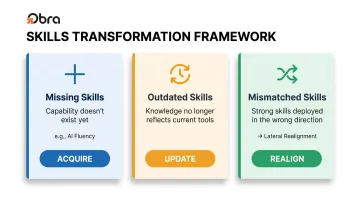
Within career pathways specifically, understanding which type of gap you're dealing with changes the response entirely. Missing skills require acquisition; outdated ones require updating. A mismatched skill, however, often points to a lateral move or role realignment — not more training.
A skills gap is not a dead end. It's a measurable distance — and identifying the type of gap determines which path forward actually makes sense.
Why Skills Gaps Derail Career Pathways
Skills gaps and career momentum are tightly linked. A clear career path motivates employees to invest in development. Without a plan to close capability gaps, that path stalls and disengagement follows.
The Retention Cost
Development opportunities aren't a perk. They're a retention lever. Gallup research found that 42% of voluntary departures are preventable — with career development consistently cited among the top factors employees say their manager or organization could have addressed. 51% of U.S. employees are watching for or actively seeking a new job, the highest level since 2015.
When employees don't see a credible path to grow their skills in alignment with their goals, they leave — taking institutional knowledge with them. Replacement costs reflect how steep that loss is:
- Frontline employees: ~40% of annual salary
- Technical professionals: ~80% of annual salary
- Managers: up to 200% of annual salary
The Organizational Cost
Skills gaps don't just frustrate individuals; they create measurable operational drag. The U.S. skills gap costs the economy approximately $1.1 trillion annually, and Korn Ferry projects $8.5 trillion in unrealized global revenues by 2030 from talent shortages.
Why Generic Training Fails
Most organizations recognize the problem but respond ineffectively. The issues with common approaches:
- Generic training programs lack personal relevance and career connection — fewer than 5% of large-scale upskilling programs reach the measurement stage
- Rigid upward-only career ladders don't account for lateral development or role evolution
- External hiring alone is expensive, slow, and doesn't address the root cause
The WEF projects that 39% of workers' core skills will be transformed or outdated between 2025 and 2030. Addressing skills gaps is a business continuity issue, not an optional HR initiative.
How to Conduct a Skills Gap Analysis
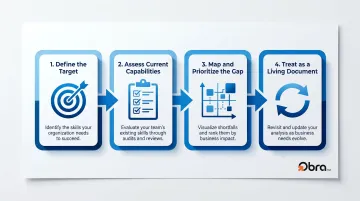
A skills gap analysis is a structured process for comparing current capabilities against the skills required for a target role or career stage. It can be conducted individually, with a manager, or across entire departments by HR. Here's a practical four-step framework to run one that actually sticks.
Step 1: Define the Target
Identify the specific role, level, or career milestone you're working toward. Pull required competencies directly from job descriptions, internal role frameworks, or industry standards.
"Leadership skills" is too vague to act on. "Facilitating cross-functional decision-making with stakeholders at the VP level" is actionable and measurable — specificity is what makes the gap closable.
Step 2: Assess Current Capabilities
Honestly inventory existing skills and their proficiency levels. Useful methods include:
- Self-assessment against each competency
- Manager evaluation
- 360-degree peer feedback
- Performance data and project history
Proficiency level matters. Having "some experience" with a tool is different from being able to teach it — and that distinction directly affects what development is needed.
Step 3: Map and Prioritize the Gap
Compare target competencies against current ones. Categorize each as missing, partially developed, or already strong. Then prioritize by two factors:
- Urgency — how soon is this skill needed for the next career step?
- Feasibility — how quickly can this gap realistically be closed?
Focus development resources on high-urgency, high-feasibility gaps first.
Step 4: Treat It as a Living Document
A skills gap analysis done once and filed away provides no value. Roles evolve, industries shift, and the target moves. Build in quarterly or bi-annual reviews to keep the analysis current.
According to research from the Association for Talent Development, only 30% of L&D professionals currently track gap closure as a business metric — which explains why so many development plans lose momentum before they deliver results.
Strategies to Bridge Skills Gaps and Keep Career Paths Moving
Targeted Learning and Development
Generic training and career-connected learning are not the same thing. Targeted L&D ties specific learning activities to a defined competency gap and a career milestone the employee can actually see.
According to LinkedIn's Workplace Learning Report 2024, employees who set career goals engage with learning content 4x more than those who don't. The top reason individuals spend more time learning: it helps them make progress toward their career goals.
Effective formats include online certifications, stretch assignments, job shadowing, and project-based learning — with the key being the explicit link between the learning activity and the next career step.
Mentorship, Coaching, and Peer Learning
Collaborative learning closes practical skills gaps faster than self-directed study alone. Working alongside more experienced colleagues, being coached through challenging projects, or participating in cross-functional problem-solving builds real capability that classroom training rarely replicates.
Among organizations with mature career development initiatives, 57% offer mentorship programs, and 47% invest in mentoring specifically to boost retention. That said, mentorship only works when it's structured. Currently, only 37% of professionals report actually benefiting from their organization's mentoring program — despite near-universal adoption.
Internal Mobility and Lateral Moves
Not all skills growth requires moving up. Moving across roles, functions, or teams builds a broader capabilities profile — and organizations that prioritize this see measurable results.
Employees stay 41% longer at companies that regularly hire from within. Yet only 33% of organizations have formal internal mobility programs — meaning most companies aren't using one of the most accessible retention tools available to them.
Apprenticeships and Earn-While-You-Learn Models
For technical, trades, and healthcare roles, formal apprenticeships are among the most effective gap-closing tools. The U.S. had approximately 678,000 active registered apprentices by 2025 — an 88% increase from 2015. The model benefits everyone: employees earn while developing, and employers train workers to exact organizational standards.
Build a Personal Development Roadmap
A written plan turns unclear intentions into trackable progress. An effective personal development roadmap includes:
- A clearly defined target role, not just a vague direction
- Named competency gaps, not broad "areas for improvement"
- Learning activities tied directly to each identified gap
- Realistic timelines with a milestone for each development action
- Scheduled review dates — built in from the start, not added later
A written roadmap also makes it easier for managers to advocate for resources on the employee's behalf — and it signals intentionality that tends to get noticed.
Building Career Pathways That Drive Continuous Skills Growth
From Career Ladders to Career Lattices
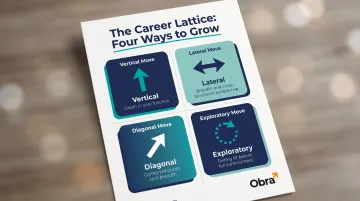
Traditional upward-only career progression no longer reflects how modern careers actually work. Organizations have flattened, and linear advancement is less common. The career lattice model — supporting vertical, lateral, and diagonal movement — better reflects the reality of skills development today.
Each type of move builds something different:
| Move Type | Primary Benefit |
|---|---|
| Vertical (promotion) | Depth in a core function |
| Lateral (different team/function) | Breadth and cross-functional perspective |
| Diagonal (cross-functional promotion) | Combined depth and breadth |
| Exploratory (trial in new area) | Testing fit before full commitment |
For employees, more pathways means more routes to fulfillment. For employers, it produces a more versatile workforce that can adapt as business needs shift.
What Makes a Career Pathway Actually Work
Three elements separate functional career pathways from aspirational documents:
- Transparency — employees know which competencies are required at each stage
- Flexibility — multiple routes exist to the same destination
- Alignment — pathways are built around future business needs, not just individual preferences
When any one of these is missing, career development stalls — employees disengage, and managers lose the language to help.
Managers as Skills Gap Coaches
Managers account for approximately 70% of the variance in employee engagement. That makes them the single most powerful lever in any skills development system — and the single biggest point of failure when they default to talent-hoarding rather than talent development.
One in four U.S. employees currently reports lacking advancement opportunities at their organization. Training managers to close that gap means equipping them to:
- Have structured career development conversations regularly
- Identify skill gaps before they become performance problems
- Connect employees to resources, roles, and stretch assignments
That's not a soft skill initiative. It's a retention strategy with measurable ROI.
When Internal Development Isn't Enough: Competency-Based Hiring
Some skills gaps can't be closed from within. The timeline is too short, the expertise too specialized, or the internal pipeline simply doesn't exist yet. When that's the case, external hiring is the right move — but only when it targets the actual competency deficit, not just an open headcount slot.
Why Traditional Hiring Misses the Gap
Keyword-matched resumes and inbound applications surface candidates who look like previous role holders. They don't reliably surface candidates with the specific competency profile needed to fill a defined capability deficit. The result is mis-hires that cost at least 30% of first-year earnings — and skills gaps that remain unfilled despite significant recruiting spend.
Skills-based hiring is increasingly the response: 81% of employers globally used it in 2024, up from 56% in 2022. Among those who made the shift, 92% found it more effective than resume-based screening.
Competency-Based Sourcing with Obra Hire
When a team needs to hire to fill a specific skills gap — not just fill a headcount slot — the search has to start from competencies, not job titles.
Obra Hire's platform searches across 800M+ verified candidate profiles using structured competency data rather than resume text matching. Hiring teams define "Must Have" and "Nice to Have" competency criteria, and the system surfaces ranked matches showing exactly where each candidate meets or falls short of those requirements.
For gap-filling specifically, these features matter most:
- Candidate pool preview — before spending any credits, teams can see pool size and preview profiles to validate that external talent exists before committing budget
- Verified profile filtering — available on Explore and Scale plans, this filters out AI-generated and fake profiles (Gartner projects this will affect 1 in 4 profiles by 2028), so outreach goes to real candidates only
- Direct contact reveal — credits unlock email, phone, LinkedIn, and resume, so hiring teams reach candidates directly without routing through third-party gatekeepers
- Free tier access — unlimited competency-based searches are available at no cost; credits are only needed when revealing contact details
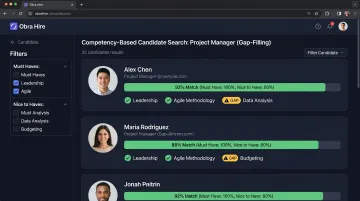
Gap-filling hiring shouldn't create new process overhead. Obra Hire integrates with 85+ ATS and HRIS platforms — including Workday, Greenhouse, and SAP SuccessFactors — so external hires flow directly into existing workflows alongside any internal development initiatives already underway.
Frequently Asked Questions
What is the skills gap in career pathways?
A skills gap in career pathways is the difference between the competencies someone currently has and those required to advance to a target role or career stage. Identifying and systematically closing that gap is foundational to meaningful career progression — for both employees and the organizations developing them.
How do you identify a skills gap in your current role?
Start by pulling the competency requirements from your target role or the next level in your career pathway. Assess your current proficiency against each requirement, then note where shortfalls exist. Input from a manager or mentor adds objectivity and often surfaces gaps that self-assessment misses.
What are the 4 types of career pathways?
The four main types are: vertical (upward promotion within a function), lateral (horizontal move to a different team or function), diagonal (cross-functional promotion), and exploratory (a planned trial in a new area to test fit and build skills before committing fully).
What are the 7 types of skills?
Common categories include: technical/hard skills, soft/interpersonal skills, digital skills, leadership skills, transferable skills, industry-specific skills, and meta-skills (such as learning agility and adaptability).
What are the top 10 career paths?
High-demand paths include data science and analytics, cybersecurity, healthcare, software development, project management, marketing, financial analysis, human resources, operations management, and skilled trades.
How long does it take to close a skills gap?
It depends on the gap's complexity and the learning method used. Minor competency gaps through targeted training may close in weeks. Significant technical or leadership gaps typically require 6–24 months of structured development. A specific written roadmap shortens the timeline by eliminating wasted effort and keeping progress visible.