Introduction
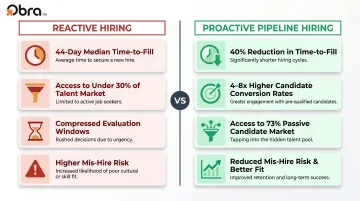
Most hiring teams don't realize they're in trouble until a key role opens and the sourcing clock starts from zero. By the time a shortlist materializes, the median U.S. time-to-fill has already stretched to 44 days — and that's the median. Technology and financial services roles routinely run 48–49 days.
For HR leaders, recruiters, and hiring managers, reactive hiring isn't just slow. It produces rushed decisions, compressed evaluation windows, and hires made under pressure rather than from choice.
A talent pipeline framework fixes this by inverting the sequence: qualified candidates are engaged and nurtured before a vacancy exists, so when a role opens, the work is already 80% done. This guide covers what a framework is, why it matters, and how to build one across five practical stages.
TL;DR
- A talent pipeline framework is a proactive, ongoing system — not a one-time project — for cultivating qualified candidates before vacancies arise.
- Done right, it shifts hiring from reactive to strategic, reducing time-to-fill and improving quality of hire.
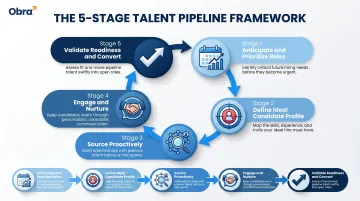
- Building one involves five stages: role anticipation, candidate profiling, proactive sourcing, ongoing nurturing, and readiness validation.
- Pipelines fail most often due to inconsistent execution and unclear ownership — not poor design.
- Technology that surfaces verified passive candidates at scale makes sustainable pipeline management achievable for any team size.
What Is a Talent Pipeline Framework?
A talent pipeline framework is a governed, repeatable process with defined ownership, segmentation rules, and a regular outreach schedule for identifying and nurturing candidates before a role is open. The word "framework" matters because it's what separates structured pipeline management from an informal list of names collecting dust in a spreadsheet.
Three related concepts are worth separating out:
- Talent pool: A static database of contacts with no active engagement. The pipeline draws from it, but a pool alone does nothing.
- Talent mapping: It tells you where qualified talent exists in the market, but doesn't move those people closer to your organization.
- Talent sourcing: The input mechanism that fills the pipeline — not the pipeline itself.
The framework ties these together into a continuous loop. Its designed outcome is specific: when a role opens, a shortlist of warm, pre-qualified candidates already exists. No scramble, no starting from zero.
Why Organizations Need a Talent Pipeline Framework
The Cost of Starting at Zero
Every reactive hire begins in the same place — zero candidates, full urgency. That combination produces single-candidate bias (moving forward with whoever shows up first), compressed evaluation, and higher rates of mismatched hires. The downstream costs compound quickly, with the U.S. Department of Labor estimating a bad hire costs at least 30% of an employee's first-year earnings.
Reactive hiring is also structurally inefficient. Applications per hire have tripled since 2021, yet average time-to-hire has increased 24% over the same period — more volume producing slower, not faster, outcomes.
What Proactive Pipeline Management Unlocks
The numbers shift significantly when hiring moves from reactive to proactive:
- Proactively sourced candidates convert at 4–8x higher rates than inbound applicants at every funnel stage
- Proactive recruiting reduces time-to-fill by approximately 40% compared to reactive approaches
- Assessment happens without urgency — which is the only condition under which quality-of-hire decisions are actually reliable
There's also a reach problem that reactive hiring cannot solve. Approximately 73% of professionals are passive candidates — not actively applying, but potentially open to the right opportunity. Organizations relying solely on job postings access fewer than one-third of the available market.
That reach gap matters most for specific hiring situations. Pipeline investment delivers the clearest ROI for organizations with:
- Recurring specialist or technical roles where sourcing time is long
- Leadership succession risk
- Niche skill requirements that rarely show up in active applicant pools
- Aggressive growth plans that will generate predictable future demand
Historically, this was a large-enterprise advantage — requiring agency retainers and dedicated sourcing staff. Platforms that offer direct access to 800M+ verified candidate profiles have made proactive pipeline management a practical option for teams of any size.
How to Build a Talent Pipeline Framework
Building a talent pipeline is a cycle, not a linear project. Each stage feeds back into the next, and the health of the pipeline depends on consistent execution of the full loop — not completing it once and moving on.
Three non-negotiables hold regardless of tools or team size:
- Named ownership for each role family — someone accountable for pipeline health
- Segmentation system that categorizes candidates by readiness and fit
- Defined touchpoint cadence that keeps profiles current and candidates warm
Step 1: Anticipate and Prioritize Target Roles
The pipeline starts before any outreach. Review attrition data, growth forecasts, and succession risks to identify the "critical few" role families where a vacancy creates the highest operational disruption. Not every role justifies pipeline investment — these are the ones that do.
Prioritization questions worth asking:
- What's the cost of this role sitting vacant for 60+ days?
- Does this role come open repeatedly, or is it a one-time need?
- Is qualified talent genuinely scarce for this role, or is supply adequate?
Step 2: Define the Ideal Candidate Profile
A success profile goes beyond a job description. It documents the specific skills, behaviors, and career trajectories that correlate with high performance — not just minimum qualifications.
This stage also has a bias dimension. Research from Harvard Business Review confirms that standardizing evaluation criteria across all candidates — before sourcing begins — reduces affinity bias and improves hiring outcomes. Defining what "good" looks like in advance is both an efficiency tool and a documented fairness mechanism.
Obra Hire's competency-based matching uses structured criteria (Must Haves and Nice to Haves) that map directly to this profiling work, surfacing candidates against defined competency criteria rather than keyword patterns.
Step 3: Source Proactively from Internal and External Pools
Both pools must run simultaneously:
- Internal high-potentials — identified through performance data and manager input — already know the organization, which keeps conversion friction low.
- Most of the external market is passive and won't apply on their own. Reaching them requires outbound sourcing, not job postings.
Obra Hire's AI-powered search gives hiring teams direct access to 800M+ candidate profiles, searchable by job title, location, experience, and skills. Recruiters can preview the estimated candidate pool size and profile quality before spending a single contact credit — a practical way to validate pipeline viability for a target role before committing resources.
Step 4: Engage and Nurture the Pipeline
A list of names is not a pipeline. It becomes one only through consistent, value-first engagement: personalized outreach, relevant industry content, company updates, and periodic check-ins that keep your organization visible to candidates who aren't actively job hunting.
Most internal pipeline efforts fail here. The reason is predictable — competing priorities, templated messaging, and no defined cadence. The engagement work gets deprioritized the moment a live vacancy demands attention.
Two data points worth knowing:
- Personalized outreach performs 15% better than bulk messages; messages under 400 characters see a 22% lift in response rates
- 42% of candidates withdraw if the hiring process moves too slowly — passive candidates disengage at twice that rate
Step 5: Validate Readiness and Convert
Readiness validation is an ongoing, low-pressure check on whether a candidate's availability, motivation, and fit have shifted since your last touchpoint. Job situations change. Interests evolve. A candidate who wasn't ready six months ago might be ready now.
Conversion — moving a candidate to active applicant status — becomes dramatically easier when Steps 1–4 have been executed consistently. By this point:
- The relationship already exists
- The candidate knows your organization and culture
- The ask feels natural rather than cold
Skip any of the earlier steps, and this moment becomes a cold outreach. Execute them, and it becomes a warm conversation.
Key Factors That Determine Talent Pipeline Success
Ownership and Governance
A pipeline without a named owner will always lose to live vacancies. Governance means:
- A specific recruiter or TA lead owns each role family
- Hiring managers participate in candidate calibration quarterly
- Recruitment ops tracks pipeline health metrics monthly
- Escalation paths exist when a pipeline goes stale
Obra Hire's Scale plan includes team collaboration with admin controls and shared credit pools — the infrastructure that makes multi-team governance operationally manageable.
Data Freshness and Pipeline Hygiene
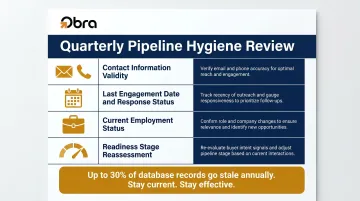
Up to 30% of database records go stale every year. A candidate profile that hasn't been touched in 90+ days should be treated as cold, not warm. A pipeline where a significant share of profiles fall into that category is effectively a false security blanket.
A quarterly hygiene review should cover:
- Contact information validity
- Last engagement date and response status
- Candidate's current employment status
- Readiness stage reassessment
Candidate Profile Quality Over Volume
A large database with low response rates tells you nothing useful about your actual pipeline strength. Profile accuracy and reachability are what drive results — and both are under pressure. Gartner projects that 25% of candidate profiles worldwide will be fraudulent by 2028, while 39% of candidates already use AI during applications. Data hygiene handles stale records; verification handles synthetic ones — and you need both.
Obra Hire's verified profile filtering specifically addresses this — filtering search results to surface verified candidates and reduce exposure to AI-generated or synthetic profiles. As AI-generated profiles grow more sophisticated, verification directly affects whether outreach lands with real candidates or disappears into a void.
Sourcing Channel Diversity
Over-reliance on a single platform caps pipeline breadth and introduces concentration risk. Effective pipelines draw from:
- Professional networks (LinkedIn, industry forums)
- Niche communities and associations relevant to the role
- Internal mobility and high-potential development programs
- Former employee alumni networks, which often yield faster re-engagement
- Direct outbound search via platforms like Obra Hire across all role types — blue, gray, and white collar
Varying the source mix improves both quality and diversity of candidates entering the pipeline.
Common Mistakes and When Not to Build a Talent Pipeline
Confusing a Database with a Pipeline
The most pervasive mistake: treating an ATS candidate archive as an active pipeline. ATS platforms were built for compliance and inbound application tracking. They have no mechanism for proactive outreach, relationship management, or readiness tracking.
Recruiters already know this instinctively. The average recruiter operates across 10–15 disconnected tools just to fill the gaps the ATS wasn't designed to close.
Underestimating the Nurture Gap
Teams routinely invest in building pipelines, then underinvest in sustaining them. The failure patterns are consistent:
- Sporadic outreach with no defined frequency
- Templated, impersonal messaging that candidates ignore
- No ownership of who follows up and when
- Pipeline work gets deprioritized when a live req appears
The result is pipeline decay — a database that looks populated but produces cold responses when a role actually opens.
When NOT to Build a Talent Pipeline
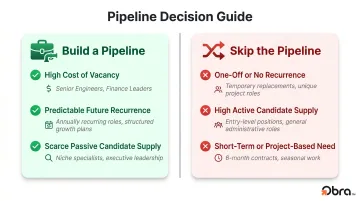
Not every role justifies the ongoing investment. Pipeline building is not cost-effective for:
- One-off "unicorn" roles with no future recurrence — the pipeline value disappears after a single hire
- Generalist or entry-level roles with high candidate supply and consistent inbound volume
- Short-term project hires where demand is specific and non-recurring
Pipeline investment is justified for roles where the cost of vacancy is high, recurrence is predictable, and passive candidate supply matters. Think senior engineers, finance leaders, or niche technical roles that routinely take 90+ days to fill through inbound alone — those are exactly where pipeline ROI compounds over time.
Conclusion
A working talent pipeline framework delivers three things: predictability in hiring, reduced dependency on reactive sourcing, and access to better candidates through relationships built before urgency sets in.
The framework's value comes from consistent execution across all five stages. Design matters far less than follow-through. A pipeline that works shows up in one clear way: organizational stability.
When a resignation hits, the response is measured — not frantic. That shift happens because:
- Candidates are already identified and engaged before a role opens
- Relationships exist before urgency forces shortcuts
- Sourcing resumes mid-process, not from a standing start
That's the difference between a pipeline on paper and one that actually moves your hiring forward.
Frequently Asked Questions
What is a talent pipeline?
A talent pipeline is the proactive process of identifying, engaging, and nurturing qualified candidates before roles become vacant. Unlike a static applicant list, it involves active relationship management — candidates are segmented by readiness and kept warm through regular contact.
What are the 5 C's of talent?
Several frameworks exist, but a common version covers Competence, Character, Collaboration, Communication, and Commitment. These help pipeline managers evaluate candidates beyond credentials — assessing qualities that predict on-the-job performance, not just resume fit.
What is the difference between a talent pool and a talent pipeline?
A talent pool is a static database of contacts who may be qualified for future roles. A talent pipeline is the active, managed process of engaging and qualifying those contacts over time. The pool is where candidates live; the pipeline is what turns them into ready-to-hire options.
How long does it take to build a talent pipeline?
Building a pipeline for a single critical role family typically takes 3–6 months to develop "ready-now" candidates, though modern outbound sourcing tools can compress that timeline. Pipeline maintenance is continuous — the 3–6 month window covers initial build, not the full lifecycle.
What metrics should I use to measure talent pipeline health?
Focus on: time-to-submit (days from requisition open to presenting qualified candidates), pipeline conversion rate (percentage of nurtured candidates who agree to interview), pipeline freshness (percentage of profiles contacted in the last 90 days), and cost-per-hire reduction versus agency or reactive sourcing.
When should you NOT build a talent pipeline?
Avoid pipelining for one-off project roles with no recurrence, generalist or entry-level positions with high active candidate supply, and urgent backfill needs that require immediate action rather than relationship building. Pipeline investment earns its return only when the cost of vacancy is high and future demand for that role is predictable.