This scenario plays out daily at staffing agencies, and time-to-fill is the single number that tells you exactly how exposed you are. It's not just an operational metric—it's a direct indicator of revenue risk, client retention, and competitive positioning.
This post covers what time-to-fill actually means for staffing agencies (it's different from corporate HR), how to measure and segment it properly, where the real benchmarks sit, what's slowing you down, and the strategies that consistently compress fill times.
TL;DR
- Time-to-fill = calendar days from job order open to candidate placement—track it per client, role type, and employment category
- One blended average hides the real bottlenecks; segmented tracking reveals where you're actually losing time
- Every unfilled day is a day you're not billing—the revenue impact compounds fast across multiple open roles
- The biggest culprits are inbound-only sourcing, vague client briefs, and scheduling delays—all fixable
- Outbound sourcing, pre-built talent pools, and process automation are the three levers that move the number most
What Is Time-to-Fill? How Staffing Agencies Should Define It
The Staffing-Specific Definition
Time-to-fill measures the number of calendar days between when a job order is officially opened and when a candidate accepts an offer or confirms a start date. The endpoint choice matters more than it seems. Some agencies use offer acceptance, others use the start date. Staffing Industry Analysts (SIA) tracks both—professional temp roles show a median of 9 days to acceptance and 14 days to start date.
Pick one endpoint and apply it consistently across every client and role type. Inconsistency in how you define the end of the clock makes all your data incomparable.
How this differs from corporate HR: In-house teams start the clock at internal requisition approval. For staffing agencies, the clock starts when a client submits a job order—and the endpoint is a billable placement, not just an accepted offer. That tie to revenue is what makes this metric more financially critical for agencies than for any internal HR team.
Time-to-Fill vs. Time-to-Hire
These are frequently confused, and they diagnose different problems:
| Metric | Clock Starts | Clock Ends | What It Diagnoses |
|---|---|---|---|
| Time-to-fill | Job order opened | Placement confirmed | Agency process efficiency |
| Time-to-hire | First candidate contact | Offer accepted | Candidate experience speed |
Time-to-fill is organization-centric. Time-to-hire is candidate-centric. Agencies need both—time-to-fill tells you if your pipeline is fast enough; time-to-hire tells you if candidates are dropping off before they get to the offer stage.
Why a Single Blended Average Misleads You
Once you've separated the two metrics, the next trap is lumping everything into one average. A 12-day fill on a light-industrial temp role and a 52-day fill on a senior finance contract are both perfectly normal. Average them together and you get a number that describes neither accurately.
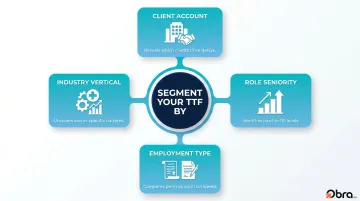
Segment your time-to-fill by at least four dimensions:
- Client account — surfaces clients with slow decision-making or vague job briefs
- Role seniority — entry, mid, and senior-level roles behave completely differently
- Employment type — temp, contract, and permanent each have distinct pipeline dynamics
- Industry vertical — tech, healthcare, and light industrial move at their own pace
How to Measure Time-to-Fill Metrics
The Core Formula
Time-to-Fill = Offer Acceptance Date − Job Order Open Date
For a role opened January 5 with an offer accepted January 22, time-to-fill is 17 days.
For an average across a period:
Average TTF = Sum of all individual fill times ÷ Number of roles filled
One important adjustment: exclude evergreen roles—positions that stay perpetually open regardless of fills. Including them inflates your average and masks the true performance of your active pipeline.
What Data Points You Need
For accurate tracking, these fields must be captured consistently in your ATS:
- Job order open date
- Date of first candidate submission to client
- Date client scheduled interviews
- Date offer was made
- Date of acceptance or start (whichever endpoint you've chosen)
If your team uses different fields for different clients—or worse, assembles this from email threads and spreadsheets—the data can't drive decisions. Standardize these fields in your ATS and automate the calculation.
The "Good Data" Problem
Only 12% of companies actively track their time-to-fill data, according to LinkedIn's Talent Blog. That gap alone makes benchmarking and process improvement nearly impossible.
Low tracking rates aren't the only problem—inconsistent definitions compound it. If some coordinators log the job order date and others log the posting date, you're not measuring the same thing. To fix this:
- Agree on field definitions at the team level and document them
- Standardize data entry in your ATS across all recruiters and clients
- Run a quarterly data audit to catch drift before it skews your benchmarks
Time-to-Fill Benchmarks: What Should Staffing Agencies Aim For?
Staffing-Specific Benchmarks (Not Corporate HR Numbers)
This is where most agencies benchmark themselves incorrectly. The SHRM 2025 Recruiting Benchmarking Report puts the US corporate average at 44 days. LinkedIn reports 66 days across all employers. Neither of those numbers is relevant to a staffing agency.
SIA's staffing-specific benchmarks tell a different story:
| Staffing Segment | Median TTF (to Acceptance) | Median TTF (to Start Date) |
|---|---|---|
| Professional Temp | 9 days | 14 days |
| Commercial/Light Industrial | 4–5 days | 4–5 days |
KORE1, a specialized IT staffing agency, reports a 17-day average for tech placements — compared to 48–89 days for corporate internal tech searches. Bullhorn's GRID 2026 report found that 56% of the highest-growth staffing firms fill roles in under 10 days.
Don't Chase Speed Without a Quality Floor
Compressing time-to-fill too aggressively backfires. Submitting under-qualified candidates to hit a timeline erodes client trust, raises replacement rates, and creates more work downstream. The right target is the fastest fill time that still meets the client's quality bar. Define that threshold explicitly during your intake process — before the clock starts.
Build Internal Benchmarks First
An internal benchmark of 12 days for temp call-center roles is far more useful than any published industry average. Industry numbers give you a rough orientation — your own historical data tells you whether you're actually improving.
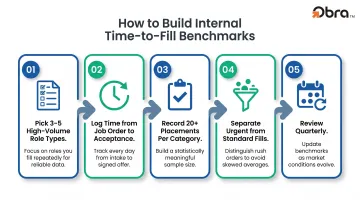
To build internal benchmarks by role category:
- Pick 3–5 high-volume role types to track first (e.g., call center, light industrial, IT contract)
- Log time from job order received to candidate acceptance — not just to first submission
- Record at least 20 placements per category before treating the average as meaningful
- Separate urgent fills from standard fills — blending them distorts your baseline
- Review quarterly, not annually — staffing markets shift fast
Once you have 2–3 quarters of internal data, compare against SIA's staffing-specific figures. That comparison tells you where your pipeline has real inefficiencies versus where you're already outperforming the market.
Why Long Time-to-Fill Costs Your Staffing Agency More Than You Think
The Revenue Math
For staffing agencies, every unfilled day has a direct dollar value. A quick way to see the exposure:
Daily revenue at risk = Annual contract value ÷ 365
A client generating $180,000 annually represents roughly $493 in daily billing. Across 10 open roles with a 10-day delay each, that's nearly $50,000 in revenue leakage—before accounting for client relationship risk.
Candidate Drop-Off Is Faster Than Most Agencies Realize
The talent availability window is brutal in competitive markets. Top-tier professionals are off the market in 7–10 days. The drop-off data reinforces the urgency:
- 78% of job seekers would drop out or consider dropping out of long or complex recruitment processes
- 42% withdraw when interview scheduling is delayed
- 52% would refuse an offer if the recruitment process was negative
In tech, healthcare, and finance, where candidates routinely hold multiple offers, a slow-moving agency simply loses those candidates to whoever moves faster.
Client Relationship Risk
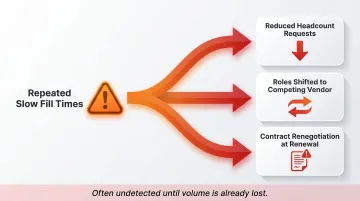
Clients experiencing repeated slow fills don't wait around. When fill times consistently run long, they typically respond by:
- Reducing headcount requests sent to your agency
- Shifting open roles to a competing vendor
- Renegotiating contract rates or terms at renewal
Slow time-to-fill is one of the most common reasons agencies lose renewal contracts—and it rarely gets flagged directly. By the time a client raises the issue, they've already moved a significant share of their volume elsewhere.
The Biggest Bottlenecks Slowing Down Staffing Agency Time-to-Fill
Sourcing Lag: The Root Cause Most Agencies Underestimate
Agencies that rely primarily on inbound applications are structurally disadvantaged. The funnel math is brutal: the overall applicant-to-hire ratio sits at approximately 1 in 180, and job openings now receive an average of 222 applications—nearly 3x the 2021 volume.
More applicants doesn't mean better applicants. It means more manual screening time before you find anyone worth submitting.
Proactively sourced candidates, by contrast, convert at 4–8x the rate of inbound applicants at every stage of the funnel. That gap compounds across every open role — and it's the single fastest lever agencies can pull to reduce time-to-fill.
Client-Side Delays
These are often overlooked because they're outside the agency's direct control—but they're not unmanageable:
- Vague or shifting job briefs force multiple rounds of candidate resubmission
- Slow interview scheduling adds days or weeks mid-process
- Unclear decision-making authority stalls offers after candidates are already engaged
- 42% of companies now require five or more interviews, and half of all interview processes run over four weeks
Agencies can't fix a client's internal bureaucracy, but structured intake processes and client SLA agreements reduce how often these delays surprise you.
Where client delays are external, internal process gaps are entirely yours to fix — and they're often the higher-leverage target.
Internal Process Gaps
These are entirely within your control and highest-leverage:
- Separate sourcing, ATS, and communication tools that don't connect force manual handoffs
- Scheduling back-and-forth adds days to every interview cycle
- No pre-built talent pools for repeat role types means starting from zero every time
- Manual candidate profile parsing slows screening before a single submission goes out
Proven Strategies to Reduce Time-to-Fill at Your Staffing Agency
Strategy 1 — Shift from Inbound to Outbound Sourcing
Waiting for candidates to apply is the single biggest structural contributor to long fill times. Outbound sourcing—proactively identifying and contacting pre-vetted passive candidates before a role even opens—changes the starting position entirely.
Platforms like Obra Hire give staffing agencies direct access to 800M+ verified candidate profiles with AI-powered competency matching. Key capabilities that accelerate fill times:
- Build a shortlist in hours, not days
- Preview candidate pool size before spending a single credit
- Confirm match quality against must-have criteria before committing resources
That preview capability alone cuts the wasted effort of sourcing blind.
Strategy 2 — Build and Maintain Role-Specific Talent Pools
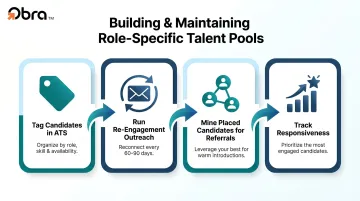
Agencies with pre-qualified pools for their most common role types cut sourcing time to near zero on repeat orders. How to build them:
- Tag candidates in your ATS by role type, skill level, and availability status
- Run re-engagement outreach every 60–90 days to keep warm candidates warm
- Mine placed candidates for referrals — your best source of pre-vetted talent is people you've already placed
- Track responsiveness — candidates who respond quickly are worth prioritizing in the pool
Strategy 3 — Standardize the Client Intake Process
Every new job order should trigger a structured intake meeting—even a 15-minute call—that locks in:
- Must-have vs. nice-to-have criteria
- Compensation range and flexibility
- Number of interview rounds and format
- Decision-maker and approval chain
- Client-side timeline commitment
This prevents the "moving goalposts" problem that forces agencies to restart candidate searches mid-process. A clear brief upfront is worth two weeks of re-sourcing later.
Strategy 4 — Automate Administrative Steps
Identify every step that consumes time without requiring human judgment—then remove it from your team's plate:
- Interview scheduling (automated calendar tools)
- Status update emails to candidates and clients
- Candidate profile parsing and tagging
- Compliance document collection
Obra Hire integrates with 85+ ATS and HRIS platforms including Workday, Greenhouse, and iCIMS, allowing candidate data to push directly into existing workflows. That integration layer means automation doesn't require rebuilding your tech stack—it just connects the pieces already in place.
Strategy 5 — Set Stage-Level SLAs, Not Just Total Fill Time
Total time-to-fill is the outcome. To improve it, you need to measure the stages:
| Stage | Example SLA Target |
|---|---|
| Job order open → First submission | 48 hours |
| Submission → Client interview scheduled | 3 business days |
| Final interview → Offer | 2 business days |
| Offer → Acceptance confirmed | 24–48 hours |
When you measure each stage, you can pinpoint exactly where time is accumulating. An agency that hits the 48-hour submission SLA consistently but loses 10 days in the interview scheduling stage has a client coordination problem—not a sourcing problem. Stage-level data tells you which intervention to make.
Frequently Asked Questions
How do you measure time-to-fill metrics?
Subtract the job order open date from the offer acceptance date (or start date—pick one and stick with it). For averages, sum all individual fill times and divide by roles filled. Use your ATS to automate this calculation rather than assembling it manually from emails or spreadsheets.
What is a good benchmark for time-to-fill?
It depends entirely on role type. Commercial temp and light-industrial roles should target 4–10 days; professional temp roles typically run 9–14 days to acceptance. Senior and technical roles can legitimately take 45–60 days. Build internal benchmarks by role category first before comparing against external data.
What is the difference between time-to-fill and time-to-hire for staffing agencies?
Time-to-fill covers the full process from job order open to placement—it's agency-centric and tied directly to revenue. Time-to-hire tracks only the candidate's journey from first contact to offer acceptance—it measures candidate experience. Both metrics are needed; they diagnose different problems.
What are the most common bottlenecks in staffing agency time-to-fill?
The top three: over-reliance on inbound applications (structural sourcing lag), slow or unclear client feedback mid-process, and disconnected internal tools that require manual coordination between sourcing, screening, and scheduling.
What should staffing agencies look for in recruitment software?
Prioritize platforms that combine outbound candidate sourcing, ATS integration, and administrative automation. Evaluate on candidate pool size, compatibility with your existing ATS, and team-wide usage support — shared credits and centralized admin controls matter more than per-recruiter licensing. Obra Hire, for example, gives agencies access to 800M+ profiles, 85+ ATS integrations, and pooled credits across the full team.