Introduction
Most hiring teams don't lose top candidates because of weak offers. They lose them because they started looking too late.
By the time a position opens, posts, and generates qualified applicants, SHRM data shows the median time-to-fill sits at 44 days for nonexecutive roles.
That delay isn't just slow — it's expensive. Each vacant position costs an estimated $4,129 over a 42-day period, with revenue-generating roles pushing well past $7,000.
Candidate pipelining fixes this by shifting hiring from reactive to proactive. Instead of scrambling when a role opens, you already have pre-screened candidates you've built rapport with — ready to move.
This guide is for HR professionals, recruiters, and hiring managers who want a practical, step-by-step system. You'll get a clear process for building a pipeline that cuts time-to-hire, lowers cost-per-hire, and keeps strong talent within reach.
TL;DR
- A candidate pipeline is a pre-vetted talent pool organized by role and readiness, built before a vacancy is posted
- Start by defining hiring needs proactively, not waiting for an open role to trigger a search
- Consistent engagement separates a working pipeline from a forgotten list of names
- Track pipeline coverage ratio and time-to-fill for pipelined roles to measure what's actually working
- Sourcing platforms, ATS integrations, and AI search let teams scale a pipeline without adding headcount
What Is a Candidate Pipeline?
A candidate pipeline is a continuously maintained group of pre-screened candidates, organized by role type or seniority, who have been nurtured enough that your team can reach out the moment a position opens. It's not a passive list — it's an active system that requires ongoing attention.
How It Differs from a Talent Pool
These terms get used interchangeably, but they're not the same thing:
| Talent Pool | Candidate Pipeline | |
|---|---|---|
| Nature | Static database of past applicants | Dynamic, actively nurtured system |
| Organization | General or unstructured | Segmented by role and readiness |
| Activity | Dormant between hires | Continuously engaged |
| Focus | Anyone who applied | Specific future roles and timelines |
A talent pool stores contacts. A pipeline moves them toward a hire.
What a Well-Built Pipeline Delivers
- Consistent access to passive candidates who aren't actively applying elsewhere
- Faster hiring cycles — candidates are already pre-qualified when roles open
- Lower dependence on inbound applications and job board traffic
- Reduced urgency hiring, which typically means better decisions and lower turnover
LinkedIn data shows 70% of the global workforce is passive — not actively job searching. Inbound-only strategies cannot reach them.
Why Building a Candidate Pipeline Matters
Reactive hiring has a predictable failure mode: when a role opens, the team posts a job, waits for applicants, and competes against every other employer chasing the same small pool of active candidates.
The cost of that approach adds up fast:
- 44 days median time-to-fill for nonexecutive roles (SHRM 2025)
- $4,683 average cost-per-hire across all roles; $28,329 for executive positions
- 69% of organizations report difficulties recruiting for full-time positions (SHRM 2025)
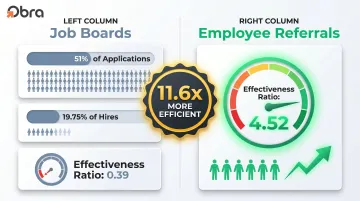
Without a pipeline, teams default to job board postings — a sourcing channel that generates high application volume but poor conversion. Jobvite's Recruiting Benchmark Report found that job boards account for 51% of all applications but only 19.75% of actual hires, yielding an effectiveness ratio of just 0.39.
Referrals, by comparison, produce a 4.52 effectiveness ratio — roughly 11.6x more efficient per application.
That gap is exactly what a candidate pipeline is designed to close. It doesn't eliminate job boards — it reduces your dependence on them by ensuring you already have warm candidates to contact when timing aligns.
How to Build a Strong Candidate Pipeline
Pipeline-building isn't a one-time project — it's an ongoing system with six interconnected stages. Get the foundation right once, and the process becomes self-reinforcing.
Step 1: Define Your Hiring Goals and Workforce Needs
Before sourcing a single candidate, answer three questions:
- Which roles do we hire for repeatedly?
- Which positions are hardest to fill, and why?
- What skills will be critical 6–12 months from now?
This is where a skills gap analysis earns its place. Compare your current team's capabilities against projected business needs. If you're expanding into a new market or launching a product that requires specific technical skills, those are the roles your pipeline should prioritize — not the positions that are easiest to fill.
Without this step, teams build pipelines for roles they can already fill quickly and neglect the ones where early investment would actually matter.
Step 2: Build Your Ideal Candidate Profile
A job description tells candidates what you need. A success profile tells your recruiting team who will actually thrive in the role.
For each pipeline segment, document:
- Core competencies and behaviors (not just technical skills)
- Motivations that align with the role's day-to-day reality
- Transferable skills that might come from non-obvious backgrounds
Emphasizing transferable skills over rigid title requirements expands your accessible talent pool — and directly supports diversity hiring goals by reducing the tendency to hire only from familiar backgrounds.
Step 3: Source Candidates Proactively Across Multiple Channels
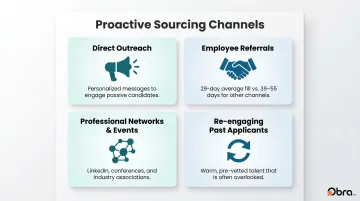
Waiting for inbound applications is the weakest sourcing strategy available. Here are four channels that consistently outperform it:
- Direct outreach to passive candidates — Personalized messages to people who match your success profile, whether or not they're looking
- Employee referral programs — Your team's networks contain pre-vetted candidates who already understand your industry; referral hires fill in an average of 29 days vs. 39–55 days for other channels
- Professional networks and industry events — LinkedIn, conferences, and professional associations surface candidates before they enter the active market
- Re-engaging strong past applicants — Your ATS contains people who were qualified but not hired; they're warm, already vetted, and often overlooked
For outbound sourcing at scale, Obra Hire gives hiring teams access to 800M+ verified candidate profiles searchable by job title, location, years of experience, skills, and company history. Recruiters can preview the size and quality of their candidate pool before spending any credits — validating a search before any financial commitment.
When contact is revealed, each unlock delivers email, phone number, LinkedIn profile URL, and resume in a single record.
Step 4: Organize and Segment Your Pipeline
A pipeline with no structure is just a list. Segment candidates into readiness tiers so your outreach frequency matches where each person actually is:
- Ready now — Active in their search, open to moving quickly
- Ready in 6–12 months — Engaged but not urgently looking; check in quarterly
- High potential / long-term nurture — Strong fit, but early career or firmly planted; keep warm annually
Centralize all candidate records in a single ATS or CRM. Fragmented data across spreadsheets, email threads, and individual recruiter notes creates duplicate outreach, missed follow-ups, and pipeline gaps that appear without warning when a role suddenly opens.
Obra Hire's team collaboration features address this directly — multiple recruiters can work the same pipeline simultaneously using shared contact records, eliminating duplicate outreach before it happens.
Step 5: Engage and Nurture Candidates Over Time
A pipeline only functions if candidates stay warm. That means consistent, meaningful contact — not just check-ins timed to your open reqs.
Effective engagement looks like:
- Personalized messages that reference the candidate's specific career trajectory
- Congratulating professional milestones (promotions, publications, speaking engagements)
- Sharing relevant industry content or job market insights
- Framing conversations around their career goals, not your current openings
Cadence is just as important as content. Talentech's research shows nearly 48% of candidates lose interest if they haven't heard from you within one week of initial contact. On the other side, over-contacting pushes people away. Agree on a communication cadence early in the relationship — some candidates are comfortable with monthly contact; others prefer quarterly.
The goal is to be the first call they make when they're ready to move.
Step 6: Measure Pipeline Health and Adjust
Start with the pipeline coverage ratio — the number of qualified pipeline candidates relative to your projected hiring targets. Borrowing from sales pipeline logic, targeting 3–5 qualified candidates per open requisition gives your team options without creating unsustainable workload.
Track these four metrics alongside it:
| Metric | What It Signals |
|---|---|
| Application-to-interview conversion rate | Whether your sourcing is reaching qualified candidates or generating noise |
| Time-to-fill: pipelined vs. non-pipelined roles | The ROI of your pipeline investment in concrete days saved |
| Offer acceptance rate | Pipeline relationship quality; industry average is ~90%, top organizations hit 95%+ |
| Candidate drop-off by pipeline stage | Where candidates disengage — interview scheduling, communication delays, or process length |
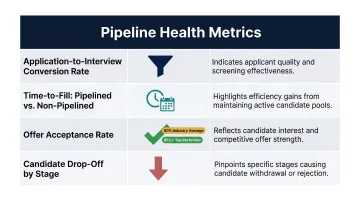
If pipelined roles are filling 10–15 days faster than non-pipelined ones, your system is working. If acceptance rates are lagging, the issue is likely in candidate experience or engagement quality, not sourcing volume.
How to Maintain and Strengthen Your Pipeline Over Time
Building a pipeline takes effort — keeping it useful takes discipline.
Conduct Regular Pipeline Audits
Candidates change jobs, lose interest, and go off-market. A pipeline that isn't reviewed decays. Schedule quarterly audits to:
- Review each segment's health and size relative to hiring targets
- Remove contacts who've gone cold or are no longer a fit
- Re-engage dormant candidates with updated, personalized outreach
Use Employer Branding as a Passive Intake Channel
Candidates who discover your organization through content arrive pre-warmed — no cold outreach required. Effective passive intake tactics include:
- Employee spotlights that humanize your team and culture
- Transparent compensation ranges that filter for aligned candidates
- Authentic behind-the-scenes content across LinkedIn and careers pages
These candidates already know who you are, which shortens the nurturing process considerably.
Don't Overlook Internal Mobility
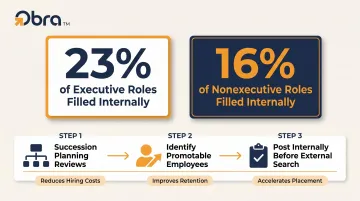
SHRM data shows only 23% of executive roles and 16% of nonexecutive roles are filled internally — most organizations are leaving their own talent on the table. Running succession planning reviews, identifying promotable employees, and posting roles internally before going external reduces external hiring costs and improves retention.
Keep Your Tools Connected
Even strong pipelines break down when data lives in disconnected tools. Obra Hire integrates with 85+ ATS and HRIS platforms — including Workday, Greenhouse, iCIMS, Lever, and SAP SuccessFactors — so candidate data stays current and pipeline activity is visible across your full recruiting team, not siloed in individual recruiter accounts.
Common Mistakes That Derail Candidate Pipelines
Building a List and Never Contacting It
A cold pipeline is useless. If candidates haven't heard from you in six months, they've mentally moved on — and when you do reach out, your response rates will reflect that. Set a minimum engagement frequency standard for each readiness tier and hold the team accountable to it.
Building Generic Pipelines Not Tied to Specific Roles
Pipelines without focus waste recruiter time. If you're nurturing a broad pool of "potential hires" with no role alignment, those candidates won't match your open reqs when timing finally lines up. Every pipeline segment should trace back to a specific hiring need identified in Step 1.
Neglecting Candidate Experience
Poor hiring experiences don't just lose you the candidate in front of you — they cost you future pipeline candidates too. Research shows 52% of candidates would decline a job offer after a negative hiring experience, and 72% share that experience publicly.
The most common culprits are all preventable with basic process discipline:
- Slow or absent follow-up after initial contact
- Ghosting candidates mid-process
- Impersonal outreach that treats people like entries in a spreadsheet
Frequently Asked Questions
What is a candidate pipeline?
A candidate pipeline is a managed, continuously nurtured group of pre-qualified candidates organized by role and readiness level. It's designed to shorten time-to-hire by ensuring your team has warm, vetted contacts to reach out to before a vacancy is ever posted.
How do you build a candidate pipeline?
Start with these core steps:
- Define hiring needs and priority roles
- Build ideal candidate profiles for each segment
- Source proactively across multiple channels
- Organize candidates by readiness level
- Nurture relationships consistently
- Track pipeline health metrics to identify gaps
What is the difference between a talent pool and a candidate pipeline?
A talent pool is a static database of past applicants — it sits dormant between hires. A candidate pipeline is an active, segmented, relationship-driven system aligned to specific roles and readiness timelines, requiring ongoing engagement to stay useful.
How long does it take to build a candidate pipeline?
A foundational pipeline can be established in a few weeks. A pipeline that meaningfully reduces time-to-hire typically requires 2–3 months of consistent sourcing and engagement before it produces measurable results.
How do you keep candidates engaged in a pipeline?
Personalize outreach around each candidate's career goals, share relevant content, and acknowledge professional milestones. Agree on a communication cadence early — quality of contact matters more than how often you reach out.
What metrics should you track to measure pipeline success?
Focus on these five indicators:
- Pipeline coverage ratio — are enough candidates queued per open role?
- Time-to-fill for pipelined vs. non-pipelined roles
- Application-to-interview conversion rate
- Offer acceptance rate
- Candidate drop-off by pipeline stage