
Introduction
Hiring the wrong person is expensive — far more than most teams realize. According to SHRM, the total cost to hire can reach three to four times a position's salary, with recruiting, onboarding, and training costs climbing as high as $240,000 per bad hire.
Yet despite those stakes, most hiring decisions are still made subjectively. A 2026 Korn Ferry survey found that 71% of senior HR leaders rely on gut instinct for talent decisions.
SHRM reports many hiring managers reach a verdict within the first five minutes of an interview — before a candidate has had a real chance to demonstrate anything meaningful.
Interview scorecards address this head-on. They give every interviewer a shared evaluation framework, replace personal impressions with job-specific evidence, and create a defensible record of how each hiring decision was made.
This guide covers what scorecards are, what makes them work, how to build one from scratch, and the mistakes that quietly undermine even structured evaluation processes.
TL;DR
- Interview scorecards replace gut instinct with consistent, criteria-based evaluation tied to the actual job
- Effective scorecards include weighted criteria, a behaviorally anchored rubric, and space for notes tied to specific examples
- Build criteria before interviews begin, with alignment from HR, the hiring manager, and a current team member
- Submit scores independently before any group debrief — group discussion before scoring skews individual ratings
- Scorecards work best paired with structured interviews and a disciplined post-interview review process
What Is an Interview Scorecard?
An interview scorecard is a structured evaluation form that lists the competencies required for a role and provides a consistent scale for rating each candidate against those criteria. Done right, it replaces gut-feel impressions with measurable, comparable data — giving every candidate a fair shot and every hiring decision a paper trail.
Sorting Out the Terminology
These three terms get used interchangeably but serve distinct functions:
| Term | What It Is |
|---|---|
| Scorecard | The document an interviewer fills out per candidate |
| Scoring matrix | The grid mapping competencies to rating scale columns |
| Rubric | Written definitions that anchor what each score means |
All three work together. Without a rubric, a scorecard is just a blank form — interviewers fill it in however feels right. Without a scoring matrix, a rubric is just a description with no way to compare candidates side by side. Together, they give evaluation structure that holds up to scrutiny.
Where Scorecards Fit in the Hiring Process
Scorecards are not standalone documents — they belong inside a structured interview process. That means:
- Criteria defined before any interviews begin
- All interviewers aligned on what "good" looks like for each competency
- Scores submitted independently, then reviewed collectively in a structured debrief
A scorecard dropped into an unstructured process won't fix inconsistency — it'll just formalize it. The sections that follow walk through how to build one that actually works.
Why Interview Scorecards Lead to Better Hires
Objectivity and Bias Reduction
When every interviewer uses the same predefined criteria, evaluation shifts from personal impression to evidence-based assessment. The numbers on bias are hard to ignore: SHRM Labs data shows 48% of HR managers admit that biases influence their candidate selection. A separate resume study found white-sounding names received 9% more callbacks than identical resumes with Black-sounding names.
Scorecards don't eliminate bias entirely, but they reduce it substantially by anchoring every evaluation to observable, job-related behaviors rather than instinct or affinity.
Consistency Across Interviewers and Rounds
In multi-round hiring, different interviewers naturally apply different internal standards. One person's "strong communicator" is another's "average." Scorecards solve this by ensuring a phone screen and a final panel interview measure candidates against the same benchmarks — making comparisons meaningful rather than accidental.
Documentation, Compliance, and Defensibility
Scorecards create an auditable paper trail showing every candidate was evaluated on job-related criteria. This matters for two reasons:
- EEOC compliance — selection procedures with disparate impact on protected groups must be validated as job-related. EEOC v. Ford Motor Co. resulted in an $8.55 million settlement over a test that lacked that validation
- Record retention — federal contractors must retain hiring documentation for a minimum of two years; best practice extends this to three
When a hiring decision is challenged, a completed scorecard is the difference between a defensible process and an exposed one.
Key Components Every Interview Scorecard Needs
Competency Criteria
Each scorecard must list specific, observable behaviors — not generic traits. The difference matters:
- ❌ "Good communicator"
- ✅ "Translates technical concepts clearly for non-technical stakeholders"
Vague traits invite inconsistent interpretation. Behavioral competencies give interviewers something they can actually observe and score. The more specific the criterion, the more consistent the scoring across interviewers.
Aim for 4–6 core competencies per role. More than that, and interviewers start rushing through criteria rather than evaluating them carefully.
Weighting
Not all competencies carry equal importance. Assign weights (either as multipliers or percentages) so must-have skills drive the total score proportionally more than nice-to-haves.
Example for a sales role:
| Competency | Weight |
|---|---|
| Closing technique | 3x |
| Objection handling | 2x |
| Product knowledge | 1x |
| Time management | 1x |
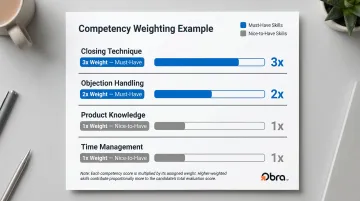
Without weighting, a candidate who scores well on peripheral skills can outrank someone far stronger on the core requirements.
Scoring Scale with a Defined Rubric
A 1–5 scale is only useful when each number has a written definition. Otherwise, one interviewer's "3" is another's "5."
Example rubric:
- 1 — Response misses the mark; no evidence of the competency
- 2 — Partial evidence; significant gaps remain
- 3 — Meets baseline expectations for the role
- 4 — Exceeds expectations; clear, specific examples provided
- 5 — Exemplary depth; response demonstrates mastery beyond role requirements
Behaviorally Anchored Rating Scales (BARS), which tie each score to specific behavioral examples, are associated with greater predictive validity and less bias than generic numerical scales. They take longer to build but deliver meaningfully more reliable results.
Comments and Evidence Fields
Scores without context are almost useless in a debrief. Every criterion needs a space where the interviewer records the specific thing the candidate said or did that justified the score. Both outcomes matter in a debrief:
- Reduces post-interview score inflation (it's harder to inflate a score when you have to write down why)
- Gives the hiring team something concrete to discuss rather than reconstructing vague impressions
Overall Recommendation and Total Score
The summary section should include the weighted total score and a clear hiring recommendation — typically a five-point scale:
Strong Yes / Yes / Maybe / No / Strong No
This recommendation must be submitted independently by each interviewer before any group discussion. If it isn't, the first person to speak will anchor everyone else's ratings.
How to Build and Use an Interview Scorecard
Defining Criteria Before Interviews Begin
Start by reviewing the job description with the hiring manager. Identify the 4–6 competencies most predictive of on-the-job performance, and push past generic traits. If "passionate" appears in your criteria, replace it with something observable — for example, "proactively brings solutions to problems without being prompted."
Before finalizing any scorecard, align HR, the hiring manager, and at least one current team member on what top performance looks like. Misalignment at this stage surfaces later as conflicting recommendations that no debrief can resolve.
Conducting Interviews and Scoring in Real Time
Score immediately after each interview, before speaking to any colleague about the candidate. Memory decays fast, and other people's opinions will shape your recall of what you actually observed. The score should reflect what the candidate said, not how you feel about them in retrospect.
The scorecard captures predefined criteria, but not everything worth noting. If something notable surfaces outside those criteria (an unexpected strength, a red flag, an unusual response) write it down. These observations won't change the score but give the team useful context when reviewing edge cases.
Key scoring discipline to maintain:
- Complete the scorecard within 15 minutes of the interview ending
- Record specific examples, not general impressions
- Avoid discussing candidates with other interviewers until all scorecards are submitted
- Flag any criteria where you had insufficient evidence to score confidently
Post-Interview Review and Decision-Making
Run a structured debrief:
- Collect all completed scorecards before the meeting starts
- Aggregate scores so the hiring team can see the numbers at a glance
- Each interviewer shares their rating and evidence before open discussion begins
- Let the data drive the conversation, but not dominate it. Qualitative judgment still matters, especially for close calls
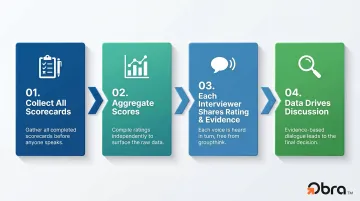
The aggregated data should structure the debrief, not replace it. A candidate who scores well on every criterion but raises a consistent concern across multiple interviewers deserves a real conversation, not just a tally.
Common Scorecard Mistakes and How to Fix Them
Vague or Generic Criteria
The most common failure. Listing "leadership," "communication," or "culture fit" without behavioral anchors means each interviewer evaluates something different. Fix it by rewriting criteria as observable behaviors:
- ❌ "Leadership"
- ✅ "Demonstrated ability to align a team around a decision under ambiguity"
If you can't describe what a strong answer looks like, the criterion isn't ready for the scorecard.
Mismatched Scoring Standards
Leniency bias — where some interviewers consistently rate candidates higher than peers — and strictness bias both skew aggregate scores. Research found leniency bias affected the hiring status of 36% of applicants in one normalization study, with median rating variance dropping from 0.68 to 0.18 after correction.
Run a calibration session before interviews begin. Walk the team through the rubric together:
- Present 2-3 sample candidate answers at different quality levels
- Align on what each score level looks like in practice
- Resolve disagreements before the first interview — not during debrief
Reviewing Scorecards as a Group Before Individual Submission
When interviewers share opinions before submitting scores, the first person to speak anchors everyone else. Research confirms initial impressions correlate at r = .42 with end-of-interview scores — meaning opinions formed in the first few minutes disproportionately shape final ratings.
Every interviewer completes and submits their scorecard independently before any debrief takes place. No exceptions.
Building One Scorecard for All Roles
A universal scorecard dilutes its own effectiveness. A customer service role and a software engineering role require fundamentally different competencies — applying the same template to both produces criteria that are either too generic to be useful or irrelevant to one of the roles.
Build role-specific scorecards instead. A shared structural template is fine — but customize these elements per role before interviews begin:
- Competencies: Tied to actual job requirements, not a generic list
- Weights: Reflect what matters most for this specific role's success
- Rubric anchors: Describe strong vs. weak answers in role-relevant terms
Frequently Asked Questions
What is an interview scorecard?
An interview scorecard is a structured evaluation tool used during hiring to rate candidates against predefined, job-specific criteria. It replaces gut instinct with consistent, evidence-based scoring that can be compared across all candidates for a role.
What is the 30-60-90 rule in an interview?
The 30-60-90 framework asks candidates to describe what they plan to accomplish in their first 30, 60, and 90 days on the job. It's commonly used in final-round interviews and can serve as a useful scorecard criterion for evaluating strategic thinking and role preparation.
What are the 5 C's of an interview?
The 5 C's — Competence, Character, Chemistry, Culture, and Calling — are a common framework for evaluating candidates holistically. These categories map closely to the competency types typically included on a well-designed interview scorecard.
What are the top 5 strengths for an interview?
Commonly cited strengths include problem-solving, communication, adaptability, attention to detail, and collaboration. Scorecards help interviewers evaluate these consistently based on observed evidence — not just what candidates say about themselves.
What is the 70/30 rule in hiring?
The 70/30 rule holds that candidates should speak approximately 70% of the time while interviewers speak 30%. A well-built scorecard supports this by giving interviewers clear evaluation prompts — they spend less time improvising questions and more time listening.
What are the 7 stages of the recruitment process?
The 7 stages typically include: workforce planning, job analysis, sourcing, screening, interviewing, selection, and onboarding. Scorecards apply specifically to the interviewing and selection stages, standardizing evaluation and supporting the final hiring decision.