According to SHRM, a bad hire can cost organizations up to $240,000 when you factor in recruiting, onboarding, and lost productivity. And in many cases, that bad hire wasn't the wrong person — it was the wrong evaluation process.
Identifying skill gaps in candidates sounds simple. In practice, it depends entirely on how the role is defined upfront, which assessment methods get used, and whether recruiters know the difference between a gap that disqualifies and one that's trainable. This guide walks through the full process: how to spot gaps before they become expensive, which tools actually work, and what to do when you find one in a candidate you want to hire.
TL;DR
- Define required skills in measurable terms before screening resumes — separate must-haves from trainable ones
- Structured interviews and practical assessments reveal real skill levels; resume review alone doesn't
- Hard skill gaps and soft skill gaps require different evaluation approaches
- A skill gap isn't automatic grounds for rejection; trainability and role criticality determine next steps
- The earlier gaps are caught in the pipeline, the less time and money gets wasted on mismatched hires
What Is a Candidate Skill Gap and Why It Costs Recruiters
A candidate skill gap is the measurable distance between what a role requires and what a specific candidate currently demonstrates. This is different from the broader organizational skills gap analysis HR uses for workforce planning — here, the focus is on a single candidate evaluated against a defined role profile.
The cost of getting this wrong is concrete. A bad hire costs at least 30% of the employee's first-year earnings in direct costs, per the U.S. Department of Labor — and that figure doesn't account for missed deadlines, team friction, and restarting the hiring cycle from scratch.
Two Types of Gaps That Matter
Not all skill gaps are equal, and treating them as if they are is where most evaluation processes break down. Recruiters should be working to distinguish between:
- Critical gaps — skills the role depends on from day one that cannot be quickly trained (a sales hire without negotiation experience won't close deals while learning)
- Trainable gaps — skills that can be developed with structured support; unfamiliarity with a specific BI tool is a different problem than an inability to interpret data
The entire evaluation process should be designed to tell these two apart. The methods covered in this guide give you the structure to do that consistently — not just on instinct.
How to Identify Skill Gaps: A Step-by-Step Process
The process only works in sequence. Skipping early steps — especially the role profile — makes every downstream assessment less accurate.
Step 1: Build a Skill Profile Before Screening Begins
Work with the hiring manager to define required skills in specific, observable terms. Not "strong communicator" — but "can translate technical findings into executive-level summaries without prompting."
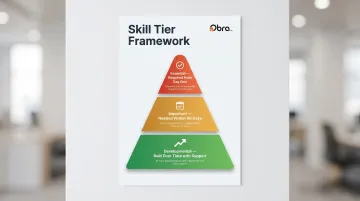
Organize skills into three tiers:
- Essential — required from day one
- Important — needed within the first 90 days
- Developmental — can be built over time with support
Then ask a harder question: which of these skills actually differentiate high performers in this role versus which appear in the job description by convention? Over-filtering on criteria that don't predict success wastes pipeline candidates who could have been strong hires.
Step 2: Scan Candidate Profiles for Skill Signals
Look beyond listed skills. The most useful resume signals are evidence of skill application — project outcomes tied to competencies, progression patterns showing development over time, and context around how a skill was actually used. Flag resumes that list skills without demonstrated application as candidates needing closer scrutiny.
This matters more now. According to a February 2025 survey by Resume Genius, 74% of hiring managers have encountered AI-generated content in applications — with 47% specifically seeing AI-crafted resumes or cover letters. Skill claims on inbound applications are increasingly unreliable.
This is where outbound sourcing has a structural advantage. Platforms like Obra Hire let recruiters search across 800M+ profiles using competency-based filters — surfacing candidates whose demonstrated experience already aligns with role requirements, rather than reviewing applications where skill claims may be inflated.
Step 3: Use Structured Assessments and Competency-Based Interviews
Structured behavioral interviews are one of the most reliable ways to surface actual skill levels. Research by Sackett et al. (2022) confirms structured interviews are the strongest single predictor of job performance — significantly outperforming unstructured conversations.
The difference comes down to how questions are framed:
- Weak: "Are you good at data analysis?"
- Strong: "Walk me through a time you used data to reverse a business decision — what tools did you use and what was the outcome?"
The follow-up probes are where you separate candidates who've genuinely done something from those who can only describe doing it.
For technical roles, add a practical assessment calibrated to the actual job. A task-based test scoped to real work conditions removes ambiguity interviews often leave. Generic aptitude tests are less useful here — the assessment needs to reflect what the candidate will actually face.
Step 4: Map Candidate Skills Against the Role Profile
Convert your evaluation into a structured data point using a simple skills gap matrix:
| Skill | Required Level (1–5) | Candidate Level (1–5) | Gap |
|---|---|---|---|
| Data analysis | 4 | 3 | –1 |
| Stakeholder communication | 3 | 4 | None |
| Python (scripting) | 5 | 2 | –3 |
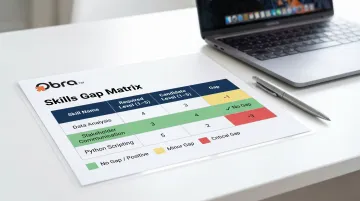
This shifts the conversation from "I felt the candidate was strong but..." to something a hiring manager can actually evaluate. Prioritize gaps by tier — a Tier 1 essential skill gap with a score of –3 is not the same decision as a Tier 3 developmental skill gap of –1.
Tools and Methods Recruiters Use to Surface Skill Gaps
The method you use to find a gap directly determines how accurately you find it. Different tools suit different skill types and role levels.
Pre-Hire Skills Assessment Platforms
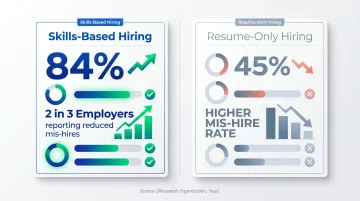
Pre-hire testing platforms screen for technical and cognitive skills before interviews consume time on both sides. The data backs them up: the TestGorilla State of Skills-Based Hiring 2025 report found that 84% of employers using skills tests are satisfied with their hires, compared to far lower satisfaction rates among those relying on resumes alone. Roughly two in three employers also report that skills tests have directly reduced the number of mis-hires.
The most effective assessments are role-calibrated rather than generic. A coding test for a mid-level Python developer should reflect the complexity and context of the actual work, not just syntax recall.
Competency-Based Interview Frameworks
Competency frameworks, where interview questions are pre-mapped to specific skills, keep gap identification consistent across interviewers. Without them, two candidates for the same role get evaluated differently, and comparison becomes unreliable. Hiring teams should align on the competency dictionary before interviews begin, not during debrief.
Outbound Sourcing with Skill-Based Filters
The earliest form of skill gap prevention happens before a candidate enters the pipeline at all. Obra Hire's competency-based matching uses structured competency data (not keyword text matching) to identify candidates whose profiles already align with a role's must-have criteria. Recruiters can set essential competencies as filters, preview the resulting candidate pool, and build a shortlist where critical gaps are already screened out.
The platform's verified profile filtering (available on Explore and Scale plans) also reduces exposure to AI-generated or fake profiles, a growing issue that Gartner projects will affect 1 in 4 profiles by 2028.
Structured Reference Checks
Most recruiters treat reference checks as a formality. A targeted conversation focused on specific competency areas can surface gaps that interviews and assessments miss, particularly for soft skills.
Ask focused questions like:
- "How did [candidate] perform when required to manage ambiguous, fast-changing situations?"
- "Can you describe a time their technical skills fell short of what the role demanded?"
These surface real behavioral evidence rather than general character vouching, and can either confirm your assessment or raise a flag worth exploring.
Common Mistakes Recruiters Make When Assessing Skill Gaps
Skipping the Upfront Skill Profile
Screening without an agreed-upon, tiered skill profile makes objective gap identification impossible. There's no benchmark to measure against, so every recruiter is effectively using a different ruler. This leads to inconsistent evaluations, inflated pipelines, and hiring decisions that vary more by interviewer than by candidate quality.
Using Credentials as Skill Proxies
Degrees, certifications, and job titles are signals, not reliable evidence of what someone can actually do. The numbers back this up: work sample tests carry a corrected predictive validity of rho = .33, while years of education sits at just r = .10 as a predictor of job performance.
Companies that have shifted toward skills-based assessment have improved hire quality, though research from the Burning Glass Institute and Harvard Business School finds that meaningful change in actual hiring behavior — not just job posting language — remains concentrated among employers who fully commit to the shift.
Treating All Gaps Equally
Disqualifying a candidate the moment any gap appears is one of the most common ways recruiters unnecessarily narrow an already tight talent pool. With 75% of employers globally reporting difficulty finding skilled talent, eliminating strong candidates over trainable gaps without considering learning velocity or role context compounds a sourcing problem that's already difficult.
Before rejecting on a gap, ask:
- Is this skill trainable within the first 90 days on the job?
- Does the candidate show evidence of fast skill acquisition in past roles?
- Is the gap in a core requirement or a nice-to-have?
What to Do When You Find a Skill Gap in a Strong Candidate
Classify the Gap First
Before making any decision, return to the critical vs. trainable distinction. Ask three questions:
- Is this skill required on day one, or is there a ramp period?
- How long does it typically take to develop — weeks or years?
- Does the organization have the structure to support that development?
A strong candidate with a trainable gap and a high learning trajectory can outperform a fully credentialed hire with limited growth potential. The matrix data should inform this call, not just instinct.
Evaluate the Candidate's Learning Signal
Look at how the candidate has responded to gaps in their own history. Have they proactively acquired skills in previous roles? Do they demonstrate self-awareness about their development areas — and more importantly, can they articulate how they'd close a specific gap?
A candidate who names their gap clearly and describes a concrete plan for closing it is significantly lower risk than one who appears unaware the gap exists.
Involve the Hiring Manager with Structured Data
Don't absorb this decision alone. Bring the skills matrix to the hiring manager with a clear framing: "This candidate meets 7 of 9 required competencies. The two gaps are [X] and [Y]. Here's our assessment of trainability and timeline." This shifts the conversation from gut-feel to structured decision-making — and it documents the reasoning if the hire is later evaluated.
Consider a Conditional Offer with a Development Plan
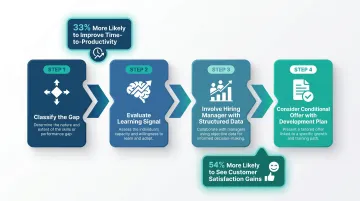
For high-potential candidates with identifiable but manageable gaps, a conditional offer tied to a structured onboarding and development plan reduces risk while preserving access to strong talent. Organizations with technology-enabled onboarding are 33% more likely to see improvements in time-to-productivity, according to Brandon Hall Group research — and those with mature onboarding practices are 54% more likely to see customer satisfaction improvements. When the gap is trainable and the candidate is motivated, structured development isn't a consolation prize; it's a deliberate hiring strategy.
Frequently Asked Questions
How can recruiters effectively identify skill gaps in candidates?
Effective identification combines upfront role skill profiling, structured competency-based interviews, and practical assessments. Accuracy improves significantly when evaluation criteria are agreed upon with hiring managers before screening begins — not after candidates are already in the pipeline.
What tools can recruiters use to identify skills and knowledge gaps in candidates?
Pre-hire skills testing platforms, competency-based interview frameworks, and structured reference checks are the core toolkit. Outbound sourcing tools with skill filters — such as Obra Hire's competency-based candidate search — also help by surfacing candidates who match specific proficiency requirements before the interview stage.
What are common examples of skill gaps in candidates?
Hard skill gaps include lacking proficiency in a required software tool, data analysis methodology, or programming language. Soft skill gaps include difficulty managing cross-functional stakeholders, weak written communication, or limited experience leading through ambiguity and organizational change.
What is the difference between a hard skills gap and a soft skills gap?
Hard skill gaps involve measurable, teachable technical competencies that can often be assessed via tests or work samples. Soft skill gaps involve behavioral and interpersonal patterns that are harder to measure — typically evaluated through behavioral interview questions and validated through reference checks on the same competency.
Should you hire a candidate with a skill gap?
It depends on whether the gap is in a critical day-one competency or a trainable skill — and whether the organization has the capacity to support development. Strong candidates with trainable gaps and demonstrated learning agility frequently outperform fully qualified candidates who have lower growth potential.
How do you assess soft skill gaps during an interview?
Use structured STAR-format questions tied to specific soft competencies, then probe for depth and consistency. Validating those observations against reference check data on the same behaviors significantly improves accuracy — neither source alone is sufficient.