Introduction
Picture a post-interview debrief where one interviewer says "great energy," another says "not sure about the culture fit," and a third can't remember which candidate they're even discussing. Twenty minutes later, the team picks whoever felt best — and six months later, that hire is gone.
This happens when evaluation lives entirely in interviewers' heads. No shared criteria. No common language. Just competing gut feelings passed off as sound judgment.
Structured interviews predict job performance with a validity coefficient of .51 compared to .38 for unstructured ones — a 34% improvement. The mechanism behind that improvement? Consistent evaluation criteria applied the same way, every time. That's exactly what an interview rubric delivers.
This guide covers:
- What an interview rubric is and why it works
- The five components that make one effective
- How to build one from scratch
- Real examples by role
- How to roll it out so your team actually uses it
TL;DR
- An interview rubric is a structured scoring tool that defines evaluation criteria, questions, and rating scales for every candidate.
- Structured interviews using rubrics lead to better hiring decisions 81% of the time vs. 38% for unstructured ones (SHRM).
- Core components: role-specific competencies, behavioral questions, a defined rating scale, and behavioral anchors.
- To build one: deconstruct the job into measurable skills, weight each competency, and anchor every score to observable behaviors.
- Consistent use requires interviewer calibration sessions — and connecting your rubric to your ATS keeps scores organized and searchable across every hire.
What Is an Interview Rubric and Why Does It Matter?
An interview rubric — sometimes called a hiring scorecard — is a pre-built evaluation framework that lists the specific competencies, questions, and scoring criteria every interviewer uses. Every candidate gets measured against identical standards, with no room for improvising or inconsistent scoring after the fact.
Four Concrete Benefits
| Benefit | What It Means in Practice |
|---|---|
| Fairness | Standardized criteria reduce unconscious bias. 48% of HR managers admit bias influences their hiring decisions — rubrics create accountability. |
| Quality | Evaluation stays focused on job-relevant skills rather than personal rapport or first impressions. |
| Efficiency | Debriefs are faster when everyone scores the same criteria. Comparisons become straightforward. |
| Candidate experience | Transparent criteria help candidates prepare meaningfully and understand what's being evaluated. |
The Cost of Getting It Wrong
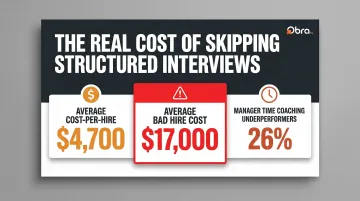
Those four benefits have a real dollar value when you look at what skipping a structured process costs. SHRM estimates the average cost-per-hire at $4,700, while each bad hire costs an average of $17,000. Managers then spend roughly 26% of their time coaching underperforming employees hired through flawed processes.
A rubric won't guarantee a perfect hire, but it gives you a documented, defensible basis for every decision and a concrete feedback loop for improving your process over time.
Key Components of an Effective Interview Rubric
Component 1: Role-Specific Competencies
Build each rubric around 4–6 competencies drawn directly from the job's core duties. Three types matter:
- Technical skills — role-specific, teachable abilities (e.g., SQL proficiency, financial modeling, coding in Python)
- Behavioral traits — patterns in how someone works, including problem-solving approach, adaptability, and how they collaborate under pressure
- Cultural alignment — fit with team values and working style, evaluated through observable behaviors rather than gut instinct
Component 2: Structured Interview Questions
Every candidate gets the same question for each competency. Behavioral questions — asking for specific past examples — are most predictive. For candidates without direct experience, situational questions ("What would you do if...") work just as well.
A simple way to structure this: one behavioral question per competency, with one situational backup ready if the candidate draws a blank or lacks relevant experience.
Component 3: A Rating Scale
Common options:
- 1–4 scale: No midpoint forces interviewers to take a position
- 1–5 scale: Middle score (3) can become a default; requires strong anchors to avoid
- Binary (Yes/No): Works well for must-have criteria like certifications or minimum experience
Label each point descriptively: "Exceeds Expectations," "Meets Expectations," "Partially Meets," "Does Not Meet."
Component 4: Behavioral Anchors
Those descriptive labels only work if interviewers know what each one looks like in practice. That's where behavioral anchors come in — without them, a "4" means something different to every person in the room.
Example — Communication competency on a 1–5 scale:
| Score | What It Looks Like |
|---|---|
| 1 | Gave vague, unfocused answers; couldn't explain their point clearly when asked to clarify |
| 3 | Communicated clearly in most responses; occasional gaps in structure or specificity |
| 5 | Answers were precise, well-structured, and adapted in real time when the interviewer probed |
Component 5: Competency Weighting
Not every criterion matters equally. A simple weighting system prevents a candidate who aces a low-priority competency from outscoring someone stronger in the must-haves:
- Critical competencies = 3x weight
- Important competencies = 2x weight
- Supporting competencies = 1x weight
Set these weights before the first interview. Adjusting them after you've met a candidate you like defeats the purpose of having a rubric at all.
How to Build an Interview Rubric: Step-by-Step
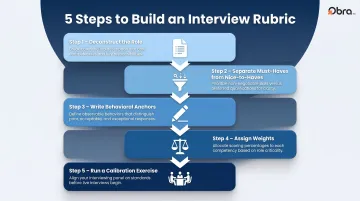
Step 1: Deconstruct the Role
Work with the hiring manager before sourcing begins. Translate the job description into measurable competencies by asking: What does excellent performance actually look like in this role? Don't copy-paste JD bullet points — translate them into observable behaviors.
Step 2: Separate Must-Haves from Nice-to-Haves
Categorize every competency into three buckets:
- Non-negotiables — deal-breakers if missing
- Preferred qualifications — add value but not required for success
- Bonus differentiators — indicators of a standout candidate
This prevents over-weighting impressive but irrelevant credentials.
Step 3: Write Behavioral Anchors
For each competency, write out what a score at the low end (1), middle (3), and top (5) looks like based on a candidate's actual responses. Keep language specific and observable.
❌ Vague: "Good communicator" ✅ Anchor: "Structured their answer with clear context, action, and outcome without being prompted"
Step 4: Assign Weights
Identify the 1–2 most critical competencies for this role and weight them more heavily. This keeps final scores aligned with actual job requirements rather than a candidate's overall impressiveness.
Step 5: Run a Calibration Exercise Before the First Interview
Have everyone on the panel independently score the same sample response, then compare and discuss discrepancies. The point isn't to reach consensus. It's to surface ambiguous anchors before a real candidate's outcome depends on them.
Interview Rubric Examples by Role
The framework stays the same across roles. What changes are the competencies and behavioral anchors. These two examples show how to adapt the same structure for very different job types — notice how the scoring anchors shift to reflect what "good" actually looks like in each context.
Customer Service Representative
| Competency | Sample Question | Score 1 | Score 2–3 | Score 4 |
|---|---|---|---|---|
| Empathy | "Tell me about a time you handled an upset customer." | Dismissed or minimized the customer's feelings | Acknowledged feelings but resolution was incomplete | Validated feelings, took ownership, reached a positive resolution |
| Communication | "Describe a time you explained something complex to a non-technical person." | Used jargon; customer remained confused | Simplified somewhat; partially effective | Clear, patient, confirmed understanding before moving on |
| Problem-Solving | "Walk me through a time you found a creative solution to a customer issue." | Escalated immediately without attempting resolution | Attempted standard resolution only | Explored alternatives, found a non-standard fix that worked |
Software Developer
| Competency | Sample Question | Score 1 | Score 2–3 | Score 4 |
|---|---|---|---|---|
| Technical Skill | "Walk me through a recent project — what architectural decisions did you make and why?" | Couldn't explain trade-offs; surface-level answers | Described decisions but reasoning was thin | Articulated trade-offs clearly with evidence of deliberate design thinking |
| Collaboration | "How do you approach code reviews — as a reviewer and as the reviewee?" | Defensive about feedback; critical without constructive framing | Accepts feedback but doesn't actively seek it | Frames reviews as shared improvement; gives specific, actionable feedback |
| Adaptability | "Tell me about a time you had to learn a new technology under time pressure." | Avoided the new tool or relied heavily on others | Learned basics but struggled to apply independently | Self-directed learning, applied effectively within the constraint |
Both examples use the same structure — competency, behavioral question, anchored rating scale, notes field — applied to what each role actually demands. Start with 3–5 competencies per role. Evaluating everything at once dilutes focus and makes scoring inconsistent across interviewers.
How to Implement and Calibrate Rubrics Consistently
Running an Interviewer Calibration Session
Before any candidate sees your panel, run a hands-on workshop: give every interviewer the same sample response, have them score independently, then compare. The target is inter-rater reliability — two interviewers watching the same candidate landing on similar scores.
Research supports why this matters: panel interviews achieve a mean inter-rater reliability of .74, while separate interviews by different interviewers average only .44. That gap doesn't close on its own — and the two biases below are usually responsible.
Two Biases to Address Directly
- Central tendency bias: Scoring everyone as "average" to avoid hard calls. Require interviewers to cite a specific quote or example from the candidate's response for every score they submit.
- Leniency/severity bias: One interviewer consistently easier or harsher than the rest. Review score distributions after each hiring cycle and flag outliers during your next calibration session.
Encourage interviewers to use the full range of the scale. A rubric where everyone scores between 3 and 4 isn't being used — it's being complied with on paper.
Integrating Rubrics Into Your Existing Workflow
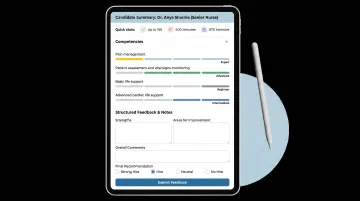
A rubric that lives in a Google Doc no one remembers to open will fail. The practical fix: build scoring directly into your ATS as a custom scorecard so it surfaces automatically during feedback submission.
Organizations using ATS-integrated scoring tools report 79% higher quality of hires and 40% lower new-hire turnover. Obra Hire integrates with 85+ ATS and HRIS platforms, including Workday, Greenhouse, iCIMS, Lever, and SAP SuccessFactors, so teams can connect their evaluation process directly to existing workflows.
From Rubric to Recruitment: Aligning Hiring Criteria with Candidate Sourcing
Most rubric guides stop at the interview stage. The bigger efficiency gain comes earlier.
If your rubric defines "Technical Proficiency" and "Adaptability" as critical competencies, those same criteria should shape who enters the pipeline before any interview is scheduled. 53% of recruiting executives expect an increase in significantly underqualified applicants in 2026 — which means the filtering has to happen upstream, not just at the scoring stage.
Obra Hire uses structured competency matching — not text-based resume keyword search — to identify candidates who already demonstrate the skills your rubric will evaluate. This keeps underqualified profiles out of the pipeline before any reviewer time is spent.
Hiring teams set "Must Have" criteria (which control who enters the candidate pool) and "Nice to Have" criteria (which sort and rank results), matching the weighting logic of a well-built rubric.
The outcome is fewer candidates who look qualified on paper but fail on the competencies that matter. When the pipeline entering your rubric has already been filtered against the same criteria, every interview hour goes further.
Frequently Asked Questions
What is an interview rubric?
An interview rubric is a standardized evaluation guide used during hiring to score candidates against pre-defined, role-specific criteria. It ensures every interviewer on a panel measures candidates the same way, reducing subjective bias and making hiring decisions easier to document and defend.
What are the 5 C's of an interview?
The 5 C's commonly used in hiring evaluation are Competence, Character, Collaboration, Communication, and Culture fit. Each maps to a competency category in a structured rubric — use them as a checklist when deciding which competencies your rubric should cover.
What is the difference between an interview rubric and a scorecard?
A rubric defines what "good" looks like for each competency before hiring begins. A scorecard records how a specific candidate measured up against that standard during or after the interview. Most teams combine both into one document.
How do you score soft skills objectively in an interview rubric?
Soft skills become measurable when tied to behavioral anchors — specific descriptions of what a high vs. low score looks like in response to a behavioral question. "Communication" isn't scored on general impression; it's scored on evidence from the candidate's actual answers.
What is the 30-60-90 rule in an interview?
The 30-60-90 rule refers to a candidate outlining what they plan to accomplish in their first 30, 60, and 90 days in the role. Interviewers can include this as a scored competency within the rubric — evaluating the quality, specificity, and realism of the plan against defined anchors.
What is the 70/30 rule in hiring?
The 70/30 rule is a practitioner guideline: interviewers should spend roughly 30% of the interview asking questions and 70% listening. A structured rubric makes this easier — when interviewers aren't improvising questions or scrambling to take notes, they can focus entirely on scoring what the candidate says.