Introduction
Most hiring processes still work like it's 2010. Candidates submit applications and wait — sometimes for weeks — without any acknowledgment, update, or explanation. Meanwhile, recruiters are buried in administrative work, spending an average of 17.7 hours per vacancy on scheduling, sorting, and follow-up tasks that consume time better spent on actual conversations.
The result is a predictable gap: 61% of candidates report being ghosted after an interview, and 58% expect a response within a week of applying. Most don't get one.
AI can close this gap, but only when it's applied deliberately. Used poorly, automation makes the problem worse: candidates receive generic, robotic messages and feel processed rather than considered.
Used well, AI handles the operational friction — matching, scheduling, status updates — so recruiters can focus on the interactions that influence whether a strong candidate says yes.
This article covers the specific ways AI improves candidate experience at each stage of hiring: from application and screening through scheduling, communication, and final decision.
TL;DR
- AI enables personalized outreach so candidates hear about relevant roles — not silence
- Automated status updates eliminate the communication silences that cause qualified candidates to disengage or accept competing offers
- Competency-based screening evaluates actual skills — not resume formatting — reducing wait times and inconsistent shortlisting
- Over-automation is the primary risk: AI works best on logistics, not relationship-building
- Full-funnel AI adoption drives improvements in offer acceptance rates, time-to-hire, and employer brand perception
What Is AI for Candidate Experience?
AI for candidate experience means applying intelligent automation and machine learning across the hiring funnel to make every candidate interaction faster, more relevant, and less wasteful of the candidate's time.
It spans every stage of the hiring process:
- Sourcing — identifying and matching candidates to roles based on competency fit, not just keyword overlap
- Outreach — personalizing and scaling initial contact without manual profile-by-profile searching
- Screening — evaluating candidates against structured criteria consistently and quickly
- Communication — sending timely status updates, scheduling confirmations, and follow-ups without requiring manual recruiter action at every step
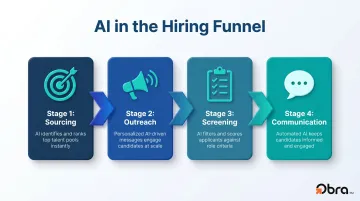
The real purpose is eliminating the delays, inconsistencies, and communication gaps that push good candidates out of the process before a recruiter ever speaks with them.
Three Ways AI Directly Improves Candidate Experience
Personalized, Proactive Outreach That Reaches the Right Candidates
Traditional inbound hiring puts the entire burden on candidates — find the job, apply, and wait. Most never hear back. AI-powered outbound recruiting inverts this: candidates receive relevant, skills-matched contact proactively, making the interaction feel targeted rather than transactional.
This shift matters because personalization moves the needle on response rates. LinkedIn's analysis of millions of InMails found that personalized messages yield 15% higher response rates compared to bulk outreach — a meaningful difference when you're trying to engage passive candidates who weren't actively looking.
The mechanism behind this is competency-based matching. Platforms like Obra Hire analyze candidate profiles against structured skill and experience criteria — not raw resume text — to surface the most relevant matches. Obra Hire's SkillsTree taxonomy covers 8,241 skills with proficiency levels, which means the outreach a candidate receives is grounded in genuine fit, not surface-level keyword coincidence.
Well-targeted outreach also shapes employer brand perception even when candidates don't convert. A recruiter who contacts someone with a specific, relevant message signals that the company actually reviewed their background. Generic mass outreach signals the opposite.
KPIs this affects: candidate response rate, time-to-engage, passive candidate conversion rate, offer acceptance rate.
When it matters most: sourcing passive candidates, filling hard-to-hire roles, and competing in tight talent markets where inbound volume is low or inconsistent.
Consistent, Real-Time Communication That Eliminates the Black Hole
The communication black hole is one of the most documented problems in recruiting — and one of the most damaging. Per Greenhouse's 2024 State of Job Hunting report, 61% of candidates have been ghosted after an interview, and 42% cite poor communication as a core frustration.
The business cost is real. UK-based Virgin Media's internal post-mortem found that rejected candidates who were also customers canceled their subscriptions at a measurable rate — translating to an estimated £4.4M in annual revenue loss.
When your customers are also your applicants, candidate experience becomes a customer experience problem.
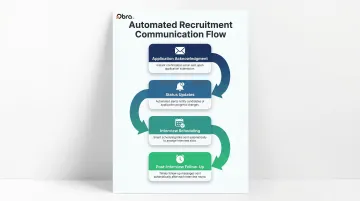
Automated communication resolves this without requiring recruiter bandwidth at every step. The key touchpoints where automation has the most impact:
- Application acknowledgment — immediate confirmation that the application was received
- Status updates — proactive notifications when a candidate advances, is placed on hold, or is not moving forward
- Interview scheduling — AI-driven scheduling that eliminates the back-and-forth of manual calendar coordination
- Post-interview follow-up — timed reminders and next-step communications that prevent candidates from sitting in silence
One constraint matters above all others: personalization. Automated messages that feel generic — "Thank you for applying to Role #4872" — erode trust even when they're fast. A brief mention of the candidate's specific skills or experience signals that a real person is involved, not just a drip sequence.
KPIs this affects: candidate drop-off rate by stage, time-to-schedule, recruiter response time, candidate satisfaction (NPS).
When it matters most: high-volume hiring environments and multi-stage processes where manual follow-up at scale is operationally impossible.
Faster, Fairer Screening That Respects Candidates' Time
Traditional resume screening is slow and inconsistent. Worse, it encodes bias. A large-scale field experiment across 83,000 applications found a roughly 9% callback advantage for white-sounding candidate names, while a 2025 Brookings study found that AI retrieval models preferred white-associated names in 85.1% of tests. These aren't fringe findings — they reflect what happens when screening relies on pattern-matching against historically unequal data.
Competency-based AI screening takes a different approach. Instead of evaluating how well a resume is formatted or which university appears in the education section, it evaluates candidates against structured skill and experience criteria. Obra Hire, for example, uses structured competency data rather than text-based keyword matching, displaying results with a clear "Must Have / Nice to Have" breakdown so recruiters can see exactly where a candidate fits — and where they don't.
The candidate experience benefit is direct: faster screening means less time in uncertainty. Candidates who are a strong fit move forward before they've accepted another offer. Candidates who aren't get a quicker, clearer answer.
The essential caveat: AI screening only reduces bias when the underlying model is trained on diverse, representative data and audited regularly by human reviewers. Automating biased historical patterns just accelerates unfair outcomes. Human oversight isn't optional — it's a design requirement.
KPIs this affects: time-to-screen, screening-to-interview conversion rate, qualified candidate yield rate, diversity of shortlist.
When it matters most: high-volume hiring, roles with large applicant pools, and organizations with explicit diversity and equity hiring goals.
What Happens When AI Is Missing
Poor candidate experience doesn't frustrate individual applicants in isolation — the damage accumulates across every open role and worsens with each hiring cycle.
When AI support is absent or underutilized, the same failure modes surface repeatedly:
- Qualified candidates — especially passive ones sourced through outbound — disengage mid-process. They weren't actively job hunting, so slow and silent processes give them every reason to walk away.
- Recruiters get buried in scheduling, follow-up, and status tracking, leaving little time for the conversations that actually move candidates toward a yes.
- Screening quality fluctuates with workload. Without structured criteria, individual recruiter judgment varies, bias is harder to detect, and shortlist quality becomes unpredictable.
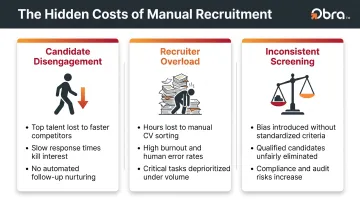
The downstream business impact is measurable: higher cost-per-hire, longer time-to-fill, lower offer acceptance rates, and a shrinking pool of candidates willing to re-engage in the future. The Virgin Media case puts a number on it — poor candidate experience, at sufficient scale, is a customer retention problem with direct revenue consequences.
How to Get the Most Value from AI in Recruitment
AI delivers the biggest candidate experience improvements when it's applied consistently across the hiring funnel — not just dropped into one stage and forgotten. Piecemeal automation swaps one bottleneck for another. The goal is continuity: every stage hands off cleanly to the next.
Three principles separate teams that get results from those that don't:
Target the stages where delays cost you candidates. Scheduling, status updates, initial screening, and outreach are where slow responses drive dropoff. Automate these. Reserve recruiter time for the conversations that actually require judgment — final-stage interviews, offer negotiations, and any moment where a candidate is on the fence.
Measure whether AI is working, not just running. Response rates, dropout by stage, and time-to-screen tell you where friction still lives. Obra Hire's preview feature — which lets hiring teams see candidate pool size and profiles before spending any contact credits — is one example of building quality checks into the workflow before money changes hands, not after.
Make the human layer visible. Automated messages don't have to feel automated. A single reference to a candidate's specific background or a role detail from their profile is enough to signal genuine outreach. Candidates who sense a real person reviewed their fit are far more likely to respond.
Conclusion
The strongest candidate experiences aren't fully automated or fully manual — they come from AI handling the operational work (matching, scheduling, communicating at scale) while recruiters focus on the human moments candidates actually remember.
That advantage builds quickly. Organizations adopting AI-assisted sourcing, communication, and screening today are shortening time-to-hire, reducing drop-off, and reaching candidates their competitors simply can't move fast enough to contact. The ones still running manual, reactive processes will keep losing qualified people to communication gaps and slow follow-up — not to better employers, but to faster ones.
Frequently Asked Questions
How does AI contribute to enhancing the candidate experience during the recruitment process?
AI improves candidate experience by enabling personalized outreach, eliminating communication gaps through automated status updates, and accelerating screening so candidates spend less time waiting and more time progressing. The result is a process that respects candidates' time rather than testing their patience.
How do AI-driven recruitment platforms affect hiring processes?
AI-driven platforms streamline the full hiring funnel — from sourcing and skills-based matching through scheduling and follow-up communication. This cuts administrative workload for recruiters while delivering a faster, more consistent experience for candidates.
Do recruiters care if you use AI for a resume?
Recruiter attitudes vary, but employers increasingly use AI screening tools that can detect AI-generated content. NACE research found only 18% of candidates are favorably impressed by employer AI screening, while 56% believe it's fair to use AI tools if employers screen with AI. Disclosing how AI is used in your hiring process builds more trust than hiding it.
Can AI in recruitment reduce bias for candidates?
AI can reduce certain forms of bias by evaluating candidates on structured competency criteria rather than subjective resume signals — but only when the underlying model is trained on diverse, representative data and regularly audited. Without human oversight, AI can just accelerate the biases already present in historical hiring decisions.
What are the risks of over-automating the candidate experience?
Fully automated hiring processes feel impersonal and transactional, eroding trust and damaging employer brand — especially when candidates receive generic messages or never interact with a human throughout the process. Automation should handle logistics; recruiters still need to show up for conversations that actually influence a candidate's decision.
How should companies balance AI and human interaction in hiring?
Use AI for high-volume, time-sensitive tasks — screening, scheduling, and status updates — while reserving recruiter attention for conversations with top candidates and final-stage decisions. The human connection at key decision moments directly influences whether strong candidates accept an offer.